


How much ASF virus does it take to cause an infection through intake of water or feed?
In a world where feed ingredients are marketed globally, do we know the minimum infectious dose to transmit the ASF virus in feed? And in water?


The pig sector events all around the world

Weekly newsletter with all the pig333.com updates
Swine industry news in your email
Pig health: news and articles on PRRS, PCV2, biosecurity, etc, Pig disease guide, atlas of pathology, clinical cases…

Biocheck.UGent is an independent, risk-based, scientific scoring system for assessing the quality of your on-farm biosecurity.

A visual and practical step-by-step guide on how to perform a necropsy on a pig.

All the information about ASF: how to recognize the disease, how it is transmitted, pictures of lesions, latest news, guides, etc.

All the information on Foot and Mouth Disease in pigs: how to recognize the disease, how it is transmitted, images of lesions, latest news, guides,...

Description of the most important diseases and conditions in pigs

Images of major swine diseases

Pig disease diagnostic tool

Definition for the most commonly used pig terms

Simulator that calculates the amount of drug to add to the water when using a flow dispenser.
Weekly newsletter with all the pig333.com updates
Pig Prices by countries. Pork production and trade. News of the pig market and the raw materials

The latest slaughter pig prices in the most important pig markets. Check the evolution of the historical prices in charts and in several currencies.

Latest quotations for the main commodities used in pig feed. Historical graphs with the pig price and estimated feed price.

Figures & trends in pig numbers, pork production and pork trade.

Global production and trade data for the most important raw materials
Weekly newsletter with all the pig333.com updates
Articles on nutrition and pig feeding, characteristics of raw materials and additives for pig feed. Prices of raw materials
Latest quotations for the main commodities used in pig feed. Historical graphs with the pig price and estimated feed price.

Technical sheets of the main raw materials and additives used in swine feed. They include a comparison of nutritional values from various sources, product
Global production and trade data for the most important raw materials
Definition for the most commonly used pig terms

Use this tool to diagnose problems with the feed conversion ratio. Click on the flowchart or on the buttons within the text to navigate through the different parts of the tool.
A biweekly newsletter with the latest developments in swine nutrition
Articles on genetics and pig reproduction: genetic improvement, genomics, artificial insemination, use of hormones

Compare production data, calculate the number of sow, nursery, and finishing spaces, and visualize your tasks on the work schedule by type of BMS.

Tool that allows you to calculate the replacement rate in your farm
Definition for the most commonly used pig terms

Use this tool to find out why your farrowing rate is less than ideal. Click on the flowchart or on the buttons found within the text to navigate through the different parts of the tool.
Weekly newsletter with all the pig333.com updates
Management, pig farm management, work planning in each production stage: management in gestation, grow finish, batch farrowing
Compare production data, calculate the number of sow, nursery, and finishing spaces, and visualize your tasks on the work schedule by type of BMS.
Tool that allows you to calculate the replacement rate in your farm
Definition for the most commonly used pig terms
Weekly newsletter with all the pig333.com updates
Design of facilities and equipment for pig farms: building design, climate control, feeding systems, etc.
Biocheck.UGent is an independent, risk-based, scientific scoring system for assessing the quality of your on-farm biosecurity.
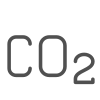
Environmental Footprint Calculator along the pork value chain.
Definition for the most commonly used pig terms
Simulator that calculates the amount of drug to add to the water when using a flow dispenser.

Use this tool to explore which slurry management strategy best fits your situation. Click on the flow chart or on the buttons within the text to navigate through the different parts of the tool.
Weekly newsletter with all the pig333.com updates

In a world where feed ingredients are marketed globally, do we know the minimum infectious dose to transmit the ASF virus in feed? And in water?
An example on how technology can be implemented in a farm for evaluation of biosecurity compliance using production parameters.
Must a veterinarian treat sick animals, whatever the circumstances or conditions that have favoured the emergence of the disease? Prophylaxis or metaphylaxis?
In addition to prophylactic measures, gilt nutrition plays a crucial role in the development of their health status. This review addresses different nutritional strategies to stimulate the immunological state during quarantine.
What is the course of this disease in the field recently? Not always following the textbook description… Global swine professionals with field experience answer this and many other questions.
Additional nutrient supply via water is a quick tool in stressing periods.
Welcome to 333
Connect, share, and interact with the largest community of professionals in the swine industry.
Celebrating 207380Users on 333!
Sign upAlready a member?

Key considerations for the design of biosecure and practical pig loading chutes that will minimize disease transmission during the animal movement process.
A group of swine professionals will describe their field experience and perspective gained while fighting against African Swine Fever.
Intranasal and intratracheal inoculation routes as well as aerosolization with foggers are discussed.
A newly produced PCR-based test can help assigning all known App serotypes, which can be used to select the most appropriate vaccine.
Why is there no effective commercial vaccine against Streptococcus suis?
Depending on the virulence of the strain and the route of exposure, the disease may have four different presentations and early detection can be a challenge due to the lack of specific clinical signs.
The European regulations state that before docking tails other measures that prevent tail-biting must be implemented, and therefore a thorough risk analysis must be carried out on each farm.
We highlight different options for segregation of clean/dirty zones at the personnel entrance into the farm. This is where biosecurity starts. Keeping it simple and easy to follow increases the likelihood of an effective protocol.
Three videos that illustrate how to make an appropriate transition between several key clean and dirty zones.
Traditional gilt exposure to seeder animals is being substituted by intratracheal inoculation and aerosol exposure.
How can we promote a healthier microbiota, favorable for the pig and for its productivity? And, when is the best time to get it?
More than 50% of all systemic samples tested by HPS PCR at the Iowa State University Veterinary Diagnostic Laboratory (ISU VDL) are positive.
Some nutritional strategies can have an antibacterial activity, do you want to know which ones?
Let's clarify what are the clean and dirty zones and its boundaries. A series of articles will discuss how to apply segregation principles to farm zones for the prevention of pathogen entry.
Do outbreaks in the same farm have a similar time-to-stability? What factors can affect time-to-stability?
Time flies and wild boar breed at a faster rate than our ability to control them.
Probiotics and amino acids to improve the intestinal barrier. Omega-3 fatty acids, plasma, probiotics, prebiotics, etc... to enhance the immune response.
The overgrowth of horn of the claw leading to slipper feet, cracking or separation, and secondary septic laminitis has a multifactorial origin.
When was the last time that you disinfected your cellphone?
71% of the farms reporting a PRRS break today will report a break within the following two years. What makes them more susceptible?
Pig reproduction and summer are not good friends, Heat comes, daylight hours drop, fertility decreases and the vets come across more reproductive pathology than during the rest of the year. Why doing always the same does not always yield the same result?