

























 0
0
General contexts
- Global pork production in 2026 would grow by 1% with increases in the United States (US), Brazil, China, and Canada more than offsetting the contraction expected in the European Union (EU). Brazil would be supported by abundant feed inputs and strong international demand, while China would achieve marginally higher production due to improvements in pigs per litter, although at slightly lower slaughter weights due to the production's pressure to reduce inventories. The EU, for its part, would face tighter margins and the impact of ASF detected in Spain at the end of 2025, which would put pressure on a reduction of its swine inventories.
- Global exports would remain practically unchanged at 10.4 million tons (Mt), with the largest increases projected from Brazil, the US, and Canada, offsetting the expected decline in the EU, whose exports would be limited by lower exportable supplies and sanitary restrictions associated with ASF.
- Chinese pork imports would register a significant decline in 2026 due to ample domestic supply, which would lead major exporters to continue seeking opportunities in other markets. The US would consolidate its pivot towards Mexico and Central America., markets between 2020 and 2025 increased their share from 25% to 46% of a total of US pork exports. The EU and Brazil, in turn, would deepen their reorientation toward Asian markets affected by ASF, such as the Philippines, South Korea, and Taiwan.

Global Indicators
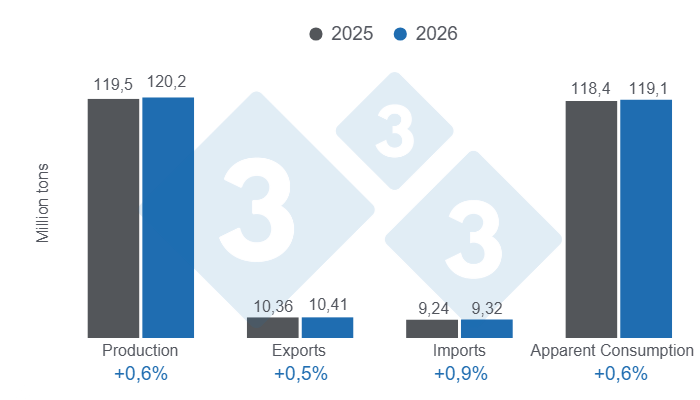
- Global pork production for 2026 would reach 120.2 Mt, representing growth of 0.6% compared to 2025 (119.5 Mt).
- Global exports would remain practically stable compared to 2025, increasing from 10.36 to 10.41 Mt, representing slight growth of 0.5%.
- Imports would reach 9.3 Mt in 2026, representing growth of 0.9% compared to 2025 (9.2 Mt).
- Apparent consumption would increase by 0.6% in 2026, rising from 118.4 to 119.1 Mt.
Main country indicators
- China would produce 59.5 Mt in 2026, representing marginal growth of 0.2% compared to 2025. In contrast, its import volume is projected to decline by 15.8% reaching 1.0 Mt, as domestic production recovery displaces external purchases below pre-ASF levels.
- EU production would decline by 1.2% in 2026, reaching 21.7 Mt, affected by tighter production margins and the detection of ASF in Spain at the end of 2025. Likewise, exports would fall by 7.6% reaching 2.8 Mt.
- In 2026, the US would increase production by 1.4% reaching 12.7 Mt, with growth in pigs per litter as the main driver despite a smaller breeding herd. Exports are also expected to increase by 3.3% reaching 3.3 Mt, supported by strong demand from Mexico and Central America, as well as opportunities created by reduced European shipments in key Asian markets.
- Brazil would increase its production by 3.2% in 2026, reaching 4.9 Mt, supported by abundant feed inputs and strong international demand. Exports are also expected to reach 1.8 Mt, representing growth of 6.8% compared to 2025, with Asia as the main destination.
- Vietnam would reach production of 4.1 Mt in 2026, representing growth of 3.9% compared to the previous year. Its imports would be around 120,00 tons, declining by 20.5% compared to 2025.
- Japan would remain one of the main global importers of pork in 2026 with 1.4 Mt, 0.3% below the estimate for 2025.
- Mexico would grow 2.9% in production, reaching approximately 1.4 Mt in 2026. I would also remain the largest importer globally and in Latin America with 1.7 Mt, representing an increase of 3.9% compared to 2025.
- Canada would increase its production by 2.1% in 2026 to 2.2 Mt, while exports would grow by 3.8% reaching 1.4 Mt.
- Colombia would remain among relevant importers with a projection of 210,000 tons in 2026, representing a growth of 2.4% compared to 2025.
April 15, 2026 | Department of Economy and Sustainability of 333 Latin America.
FAS - USDA | https://apps.fas.usda.gov/