























 0
0
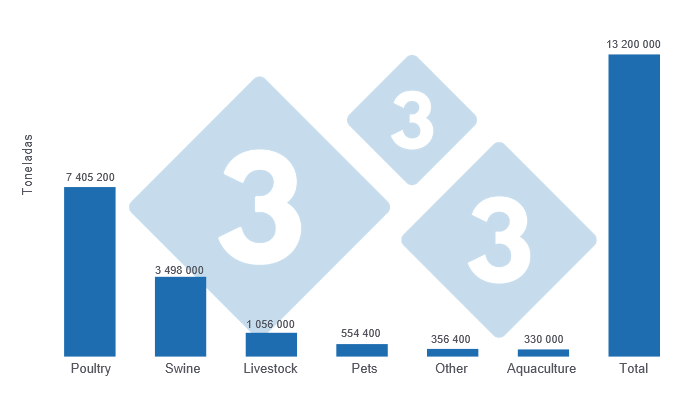
Animal feed production in Colombia totaled 13.2 million tons (Mt) in 2025, representing a 20.2% increase compared to the previous year and significantly exceeding the average growth rate of the last five years (7.1% year-on-year). Of the total volume produced, 56.1% was destined for poultry, 26.5% for swine, 8.0% for cattle, 4.2% for pets, 2.7% for small livestock, and the remaining 2.5% for aquaculture.
In 2025, 10.54 million tons of macro-ingredients were used in the production of animal feed, representing a 13.8% increase compared to the previous year. Corn was the predominant input at 7,308 tons, accounting for 69.3% (a 13.3% year-on-year increase), followed by soybean meal at 2,043 tons (19.4%, a 19.5% increase), soybeans at 595,000 tons (5.6%, a 34.2% increase), and other components at 594,000 tons (5.6%, a 10.1% decrease). Almost all of these macro-ingredients were imported, with the United States supplying 98.9% of the total and the Andean Community countries the remaining 1.2%.

Regarding micro-ingredients, the industry used 1.14 million tons in 2025, a 9.9% increase compared to the previous year. Within this group, animal-based meals (90,000 tons, +24.8%) and calcium phosphate (38,000 tons, +133.4%) registered the largest year-on-year increases, while premixes (51,000 tons) and lysine (27,000 tons) showed contractions of 5.5% and 2.1%, respectively. The main suppliers of these inputs were China (40.2%), the United States (19.7%), the Andean Community countries (16.5%), and Mercosur (14.8%).
Logistics associated with the animal feed industry generated 302,929 road trips in 2025 (830 per day), 22.7% more than the previous year, moving 261,991 containers (+3.0%) from the ports of Buenaventura (31.9%), Santa Marta (28.3%), Barranquilla (26.6%), Tolú (10.0%), and Cartagena (3.3%), with land freight revenues totaling USD 243.2 million.
Part of the animal feed production was directed to export markets: in 2025, shipments totaled 49,615 tonnes (+18.8%) with a value of USD 114 million FOB (+37.6%), reaching 40 markets overall. Exports were led by pet food, with 22,400 tonnes and a 45.2% share (+27.8% year-on-year), followed by premixes with 19,600 tonnes (39.6%, +24.2%) and other preparations with 7,500 tonnes (15.2%, -10.0%). The main destinations were Venezuela (21.9%), Ecuador (20.3%), the United States (13.9%), Puerto Rico (7.9%), and Guatemala (5.3%).
Animal feed produced in Colombia directly contributed to national food security by sustaining the production of key animal proteins in 2025: eggs (1.3 million tons, +7.7%), milk (8.405 billion liters, +9.0%), chicken (2.0 million tons, +9.5%), beef (811,000 tons, +7.6%), pork (663,000 tons, +7.8%), and fish products (251,000 tons, +3.7%). Additionally, the industry contributes to the nutrition of approximately 8,369,888 dogs and 3,548,226 cats in the country.
In terms of employment, the animal feed supply chain (which includes cereals, feed production, poultry, swine, livestock, aquaculture, and meat processing and preservation) generated 2.3 million jobs in 2025, representing 1.3% of total industrial employment and 38.7% of the population employed in all agricultural and manufacturing activities. In terms of compensation, the supply chain paid 1.2 trillion pesos in wages and salaries.
April 28, 2026/ 333 Latin America with data from ANDI – Sectoral Chamber of the Animal Feed Industry.
https://www.andi.com.co/Home/