


























 0
0
Fatty acids are organic compounds formed by a hydrocarbon chain of 2 to 12 carbon atoms and a terminal carboxyl group. Depending on chain length, they are classified as short-chain fatty acids (SCFAs) and medium-chain fatty acids (MCFAs), which determines their physicochemical properties, absorption, and biological function (Szabó et al., 2023).
Both SCFAs and MCFAs are saturated fatty acids, meaning they do not contain double bonds in their hydrocarbon chain. This saturation confers high chemical stability, lower susceptibility to oxidation, and specific solubility and absorption characteristics that explain their physiological behavior in the digestive tract.

Short-chain fatty acids
SCFAs are characterized by having between 2 and 6 carbon atoms in their hydrocarbon chain. In swine nutrition, the most commonly used SFCAs are:
- Acetic acid (C2)
- Propionic acid (C3)
- Butyric acid (C4)
- Valeric acid (C5)
- Caproic acid (C6)
At the intestinal level, SCFAs are produced through anaerobic bacterial fermentation of non-digestible carbohydrates such as dietary fiber of resistant starch, a process that occurs mainly in the colon and is primarily carried out by bacteria from Firmicutes and Bacteroides phyla (Donohoe et al., 2011).
Acetic acid is mainly produced through fermentation by Bifidobacterium and Lactobacillus. Propionic acid is primarily generated by bacteria of the genus Bacteroides and members of the Firmicutes phylum. Butyric acid, is mainly produced by Firmicutes, especially species from the Verrucomicrobiaceae and Lachnospiraceae.
Thus, increasing the content of fermentable carbohydrates in the diet though the inclusion of wheat bran, beet pulp, resistant starch (Bikker et al., 2007; Carneiro et al., 2007) or inulin (Wellock et al., 2008) stimulated SCFA production, increasing lactic acid and butyric acid levels in the small and large intestine. It has been previously described that supplementation of weaned piglets with wheat bran (40 g/kg) and beet pulp (20 g/kg) shown an increase of total SCFA concentration in the colon (Hermes et al., 2009).
SCFAs are weak acids (acids that dissociate partially in water and whose dissociation is reversible, so their conjugate base can capture protons again) that promote gastrointestinal health mainly due to their bacteriostatic activity through the reduction of the pH of the medium via the release of H+ ions, creating a less favorable environment for potentially pathogenic bacteria such as E. coli or Salmonella, and favoring the growth of beneficial bacteria such as Lactobacillus and Bifidobacterium (He et al., 2020).
Additionally, some SCFAs such as butyric acid are an important source of energy for intestinal epithelial cells. Therefore, another beneficial action for pigs is their capacity to increase the digestibility and absorption of nutrients such as protein and minerals. However, the activity of each SCFA depends on its pka, the pH of the medium in which it is found, its partition (LogP Kow) and its molecular weight (see technical info of organic acids).
Likewise, SCFAs are also capable of positively modulating the inflammatory response, immune function, and intestinal hormonal secretion, including peptides such as GLP‑1 and PYY (González-Bosch et al., 2021).
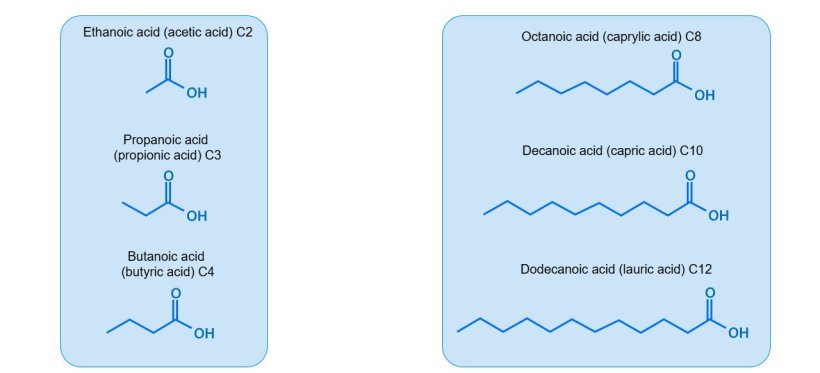
Figure 1. Structure of the SCFAs and MCFAs most commonly used in swine nutrition.
Medium-chain fatty acids
Medium-chain fatty acids (MCFAs) are characterized by having between 8 and 12 carbon atoms in their hydrocarbon chain. In swine nutrition the most commonly used MCFAs are:
- Caprylic acid (C8)
- Capric acid (C10)
- Lauric acid (C12)
All of them are saturated fatty acids, that is, they do not contain double bonds in their structure.
Unlike SCFAs, MCFAs come directly from the diet. They are found in high concentrations in coconut oil, palm kernel oil, and milk, where they represent approximately 15% of total fatty acids and constitute a key energy source for suckling piglets. in these foods, MCFAs are not usually found free, but forming medium-chain triglycerides, composed of three MCFAs esterified to a glycerol.
MCFAs are of special interest due to their antimicrobial activity.
Due to its relatively high pKa, an important proportion of MCFAs is found in non-dissociated form along the gastrointestinal tract. In addition, being liposoluble compounds, they can easily go through the bacterial membrane, which acts as semipermeable barrier. Once inside the bacterial cytoplasm, where the environment is more alkaline, MCFAs dissociate and release protons, which causes a decrease in intracellular pH. This acidification interferes with the functioning of essential enzymes and alters key metabolic processes for bacterial survival. As a consequence, the bacterial cell loses its functionality activity and finally dies.
This bactericidal effect is especially strong against pathogenic bacteria such as E. coli or Clostridium perfringens. In contrast, acid-tolerant beneficial microorganisms such as Lactobacillus, adapted to acidic environments, have greater resistance to MCFAs. In fact, at low concentrations, Lactobacilli can even use MCFAs as energy source, which explains why MCFAs can contribute to the control of pathogens without affecting the beneficial microbiota.
In addition, MCFAs are less soluble in water than SCFAs, but considerably more than long-chain fatty acids. A distinctive characteristic is that they do not require micelle formation for their absorption, being hydrolyzed by pre-duodenal lipases, and can even be partially absorbed in the stomach and in the proximal intestine, which makes them a highly available energy source. Due to this accelerated kinetics, these fatty acids have a low tendency to be stored in body fat, so they are considered metabolically more similar to carbohydrates than to traditional fats. This behavior is specially beneficial in immature animals, such as newly weaned piglets, whose capacity to digest and absorb long-chain fats is still limited.
Mode of use and supplementation
Both SCFAs and MCFAs can be included in diets as feed additives in the form of salts or in acid form, with different types of coatings and microencapsulation techniques that modulated their activity at the gastrointestinal level. This protection provides technological advantages: it improves handling and safety, increases stability, and reduces dust and corrosiveness. It also prevents damage due to temperature or pressure during processing and undesirable interactions with other ingredients.
Their microencapsulation can improve palatability and allows the release of the acid in specific areas of the gastrointestinal tract.
For example, lipid encapsulation facilitates a slow release in the intestine, enhancing its antimicrobial action at this level, reaching a reduction in coliform counts at the distal jejunum and cecum, while free organic acids do not reach this distance (Piva et al., 2007). Additionally, it allows reducing the effective dose by up to 10 times, and currently there are multiple protected or encapsulated commercial additives.
Despite their benefits, the inappropriate use of organic acids can cause undesirable effects. For example, high levels of potassium diformate (1.8%) can reduce beneficial lactic bacteria in feces, which highlights the need for precise formulation (Canibe et al., 2001). Therefore, before deciding the inclusion level, it is important to know whether an excess can cause penalties in performance and animal health depending on their age.
According to NRC (2012), a minimum daily supply of 0.5-1 g/kg body weigh/day of SCFAs and MCFAs is recommended in young piglets. These fatty acids constitute a rapid source of energy and contribute to stimulating the development and health of the intestinal mucosa.
On the other hand, a similar supply of lauric acid (C12:0) is also recommended. In addition to sharing the energetic and intestinal development support functions described above, this fatty acid presents antimicrobial properties, which can contribute to the balance of the intestinal microbiota.
All of this highlights the importance of proper characterization of diet ingredients and adequate nutritional formulation, in order to ensure that these recommendations are met in animal between 4 and 6 kg body weight at weaning.
In swine production, SCFAs and MCFAs are mainly used in two production phases: in piglets during post-weaning and in sows during gestation and lactation. In piglets, their use is mainly to improve productive performance and gastrointestinal health, while in sows, the objective of their inclusion in the diet is to improve the sow microbiota and, consequently, the microbiota of the litter, promoting both gastrointestinal health and metabolism of the sow, as well as growth and gastrointestinal health of suckling piglets (Lan y Kim, 2018).