


























 0
0
Genetics plays a key role in the future of pig production. Thanks to its extensive catalog of boars, PIC® is able to meet the needs of different markets, maximizing the success of the entire production chain in each of them (Table 1, Figure 1).
Table 1. Summary of the most used PIC® Terminal Lines in the Spanish and Portuguese Market

| Boar | PIC®408 | PIC®800 | PIC®337 | PIC®410 |
|---|---|---|---|---|
| Segment | Lean | Value added Profitability |
Profitability | Compromise between farm and slaughter results |
| Breed composition | Pietrain | Duroc | Synthetic | PIC®337 X PIC®408 |
| Carcass type | High conformation | Lean Duroc |
Heavy | Heavy |
| Target weight | 100-120 kg | 115-125 kg | 120 kg+ | 120 kg+ |
| Type | Mostly intact / castrated | Intact / castrated | Intact / castrated | Intact / castrated |
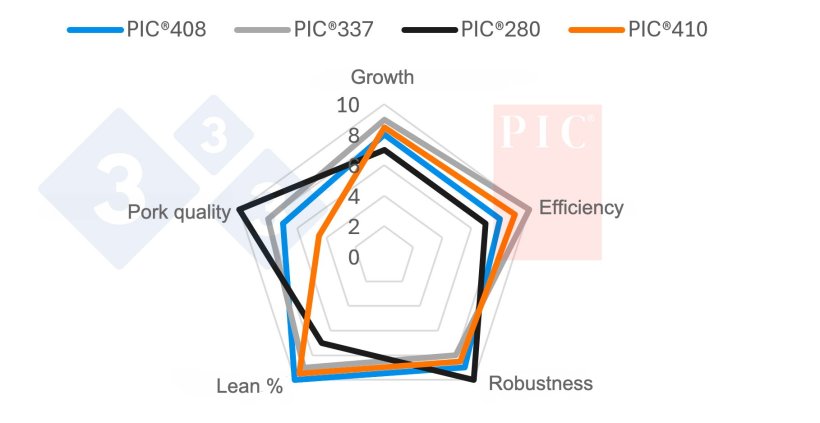
Figure 1. Diagram of the positioning of PIC® boars.
PIC®408, Lean, robust, and uniform Pietrain
The PIC®408 is a halothane-negative Pietrain line.
Target market: Producers who want to produce high-quality lean carcasses at a low production cost.
At the farm level, it is a very well-balanced sire, combining growth rate and feed conversion with very vital, robust, and uniform piglets and finishing pigs capable of growing even under adverse commercial conditions.
This makes the progeny of the PIC®408 easy to manage, profitable, and highly marketable.
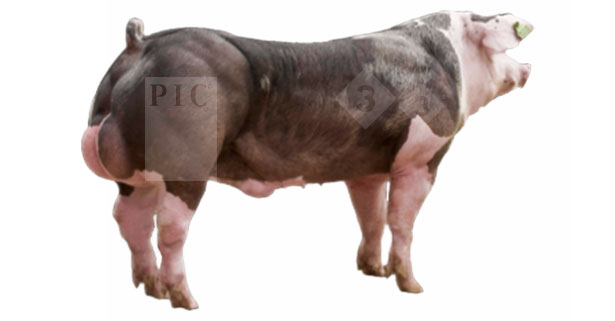
Table 2. Boar PIC®408 test results
| Type | Mean | Top 10 % | |
|---|---|---|---|
| ADG | Total | 719 | 837 |
| 6-130 kg | 772 | 898 | |
| 30-115 kg | 901 | 1049 | |
| FCR | 30-115 kg | 1.88 | 1.79 |
The PIC®410 combines the high carcass value of the PIC®408 with the excellent growth of the PIC®337.
Target market: Producers seeking above-average finishing performance without compromising carcass value. It delivers optimal-quality carcasses with reduced production costs and is suitable for the production of heavy carcasses.
PIC®800: An efficient Duroc without compromising pork quality
Target market: Producers looking for an efficient Duroc with good quality pork.
The PIC®800 genetic program combines the traditional improvement of Duroc lines in growth rate, excellent feed conversion, and carcass yield, while placing greater emphasis in recent years on the following traits:
- Robustness: Improvement of survival in finishing. Reduction in the incidence of hernias.
- Pork quality including:
- pH (meat quality during processing)
- tenderness (meat quality perceived by the consumer)
- intramuscular fat
- Improvement of carcass considering the high percentage of primal cuts.
This has been made possible due to the increase in data collected in the GNX program, which explains the improvement observed in these traits.
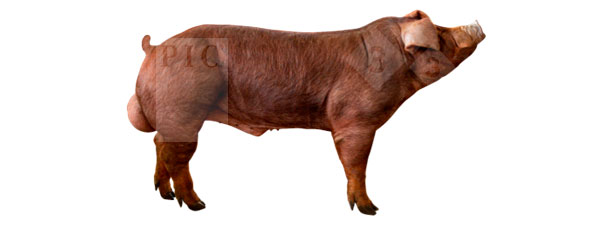
Table 3. Boar PIC®800 test results
| Type | Median | Top 10 % | |
|---|---|---|---|
| ADG | from birth to 137.8 days old | 789 | 927 |
| FCR | 30 to 115 kg | 2.12 | 1.71 |
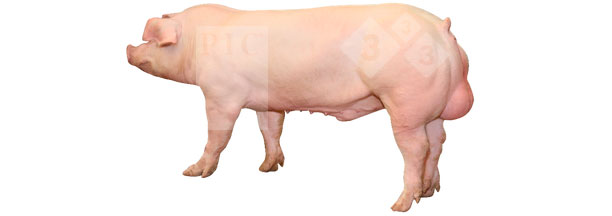
PIC®337: The genetic option to maximize performance at heavy weights
The PIC®337 is a synthetic line that has been established for more than 40 years.
Target market: This boar is selected to maximize profitability throughout the value chain. It stands out for its productive traits, combining a high growth rate with an excellent feed conversion ratio even at heavy weights, optimizing the use of finishing spaces through its average daily gain and feed efficiency, as well as its carcass and pork quality. It stands out particularly for its performance at heavy slaughter weights.
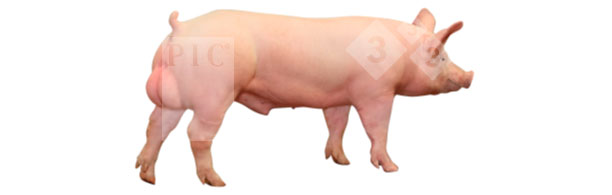
Therefore, its traits make it especially suitable for integrated customers seeking to capture the benefits it provides on the farm, in the slaughterhouse, and at the processing plant. The PIC®337 is present in more than 280 boar studs in 35 countries.
Table 4. Boar PIC®337 test results
| Type | Median | Top 10 % | |
|---|---|---|---|
| ADG | Bith to 137.8 days of age | 785 | 933 |
| FCR | 30 to 115 kg | 1.98 | 1.64 |
The role of genetics is key to its future, with the terminal sire being a crucial investment due to its high impact on the pork value chain.
