

























 0
0
On November 28 (a fateful Friday), news broke that two wild boars found dead in the Collserola mountains, behind Barcelona, had tested positive for African swine fever. Spain thus lost its status as a territory free of this disease.
The Spanish authorities (Ministry of Agriculture) and Catalan authorities (Department of Agriculture of the Generalitat) reacted decisively and energetically: an area with a radius of 6 km around the first two outbreaks (Exclusion Zone) and another area with a radius of 20 km (Quarantine Zone) were cordoned off. All necessary technical and human resources were deployed. At the time of writing, 26 wild boars found dead have tested positive, all in the exclusion zone.

Weekly tests have been conducted on each farm in the quarantine zone, with all results coming back negative.
The outlook and environment for Spanish pig farming changed suddenly, like a complete U-turn.
Initially, all third countries to which we export pork suspended Spanish imports as a basic precautionary measure. The interruption of export flows was an insurmountable obstacle for the economy of the industry as a whole; every effort had to be made to reverse this interruption as far as possible.
The EU allows normal trade in pork. The only restriction is that both the pigs and the slaughterhouse and processing facility must come from and be located outside the two areas mentioned.
Last year, Spain exported a total of 1,319,074 tons of pork products to third countries (data from Interporc). This amount represents just under 25% of total pork production. Weekly, this amounts to just over 25,000 tons, or around 1,000 25-ton containers per week. In the week of December 1 to December 5, none of the usual 1,000 containers could be shipped. This blockade was a major threat.
The Spanish pig price regulator, Mercolleida, reacted immediately (there was even an extraordinary session on Monday, December 1), lowering the price by 26 cents per kg of live weight for two consecutive weeks. From €1.30/kg live agreed on Thursday, November 27, to €1.04/kg live at present. Aware of the difficulties in accessing third countries, the board members sought to provide slaughterhouses with cheap pigs in order to place much more pork than usual within the European Union. The maneuver has been quite successful, aided by Christmas demand.
The excellent work of the Spanish authorities, working tirelessly with officials from various countries, has yielded good results in a short period of time: China (our leading export destination) had accepted regionalization a few weeks before the first outbreak. This means that China agrees to continue buying from Spain, with the exception of companies based in the province of Barcelona. This week, we learned of the Chinese authorities' final response to the anti-dumping case: of all the EU countries, Spain has come out best, with definitive tariffs of 9.80% for five years. This is good news amid the gloomy outlook. It should be noted that Litera Meats will, exceptionally and thanks to its full cooperation with the Chinese authorities, have the lowest tariffs in the entire EU: 4.98%.
Other countries have accepted regionalization: South Korea, the United States, the United Kingdom...
During the week of December 8-12, shipments to those third countries that accept regionalization have tentatively resumed.
Two of our main destinations, Japan and the Philippines, are currently refusing to accept Spanish pork. The same is true of other less important customers, such as Mexico...
We must understand that the current situation is very bad, but that it could be much worse without destinations outside the EU. We are aware that the Spanish Ministry of Agriculture is doing everything possible (and more) to try to open up as many third countries as possible. We would like to congratulate the ministry for its positive initiatives.
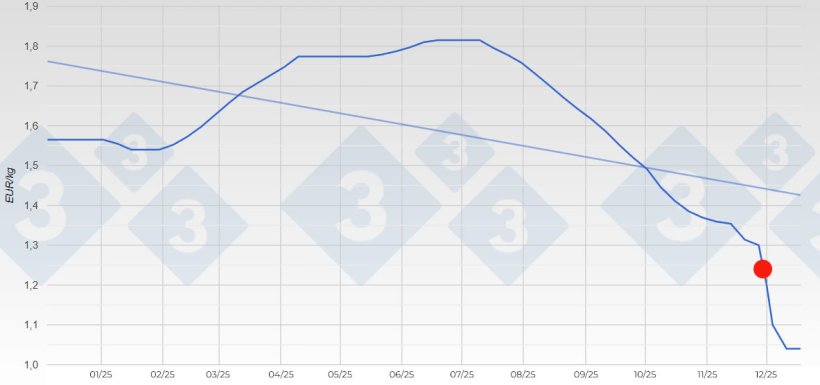
The cost of producing a live pig for slaughter is around €1.37 or 1.38/kg live weight. The current price is €1.04/kg live weight. This means that the loss is €0.33/kg live weight. With an average live weight of 125 kilograms at slaughter, more than €41 per head is lost, which is an absurd amount.
In Spain, around 1,150,000 pigs are being slaughtered every week. Spanish farmers are losing a total of more than €47 million per week. And the weeks are adding up. And no increase in the price of pigs is foreseeable until February... We will have to brace ourselves to withstand these hurricane-force headwinds. There will undoubtedly be consequences that no one wants. There will certainly be a reduction in the Spanish pig inventory.
It's the holiday season. Despite the catastrophe, Christmas will come, we will celebrate it, and it will become a thing of the past. We should be able to separate our professional lives from our private lives and enjoy time with our families during these special days. That is our wish.
In conclusion, Blaise Pascal (a famous French mathematician) stated: “Misfortune reveals lights to the soul that prosperity fails to perceive”
Guillem Burset