

























 0
0
Chile's meat production and export industry sector reaffirmed its strength and competitiveness in 2025, highlighting the undisputed leading role of the pork industry in international markets. According to the recent ChileCarne 2025 report, pork not only leads export but has also consolidated Chile as the sixth-largest pork exporter worldwide.
Record figures and comparison by species

In 2025, total meat production in Chile reached 1,569,022 tons (t) carcass weight. While poultry leads national production volume with 748,602 t, pork follows closely with 589,376 t, well above beef (196,786t) and sheep meat (34,258 t).
However, in export terms, pork is the main driver of the industry, During the year, pork exports reached 327,586 t, far exceeding poultry with 189,829 t, beef with 24,855 t, and sheep with 34,258 t.
In economic terms, pork accounted for 54% of total meat export value, generating USD 697.7 million. In comparison, poultry represented 34% (USD 439.4 million), beef 8% (USD 109.3 million), and sheep meat 4%.
Domestic consumption and key markets
At the local level, total meat consumption averaged 82.1 kg/person. Poultry led consumption with 36.1 kg/person, followed by beef with 22.0 kg/person and pork with 21.6 kg/person.
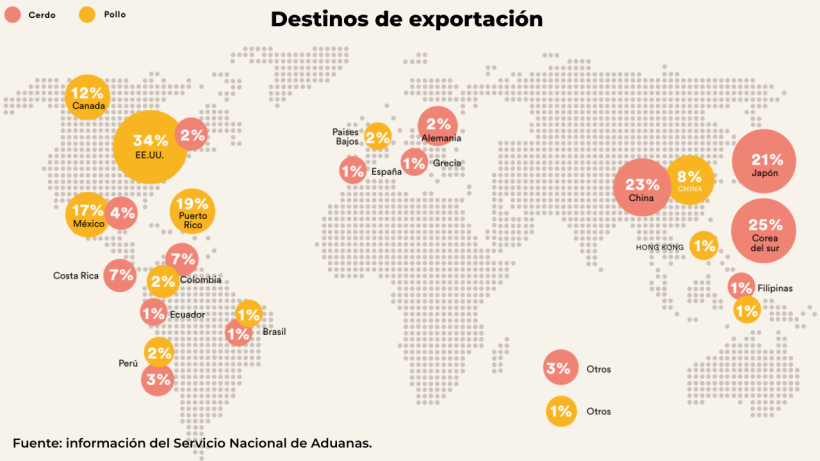
In the global market, the commercial success of Chilean pork is supported by its strong positioning in Asia. The main export destinations in 2025 were Chine (34%), South Korea (25%), and Japan (12%), in contrast to poultry, whose exports were concentrated in North America and the Caribbean, with the United States (21%), Puerto Rico (10%), and Mexico (17%) as key markets.
Advances in sustainability and animal health
The productive success of the pork industry is supported by high standards of sustainability and food safety. In environmental terms, the pork sector achieved 24% reduction in greenhouse gas (GHG) emissions over the past 20 years. Currently, 77% of national pork production is certified under the "Chile Origen Consciente" label of the Ministry of Agriculture.
In terms of animal health, pork producers have demonstrated responsible management, achieving a cumulative reduction of 42.16% in antimicrobial use between 2016 and 2024.
In the light of these results, ChileCarne president Juan Carlos Domínguez highlighted the sector's progress: "We trust that, through joint work between the public and private sectors, Chile will continue to strengthen its position as a reliable food supplier for the world, contributing to the country's economic development and the well-being of the communities where our activity takes place".
March, 2026 | Departament of Economics and Sustainability, Pig 333 Latin America
ChileCarne | ChileCarne Report 2025 | https://chilecarne.cl/wp-content/uploads/2026/03/Reporte-Chilecarne-2025.pdf