

























 0
0
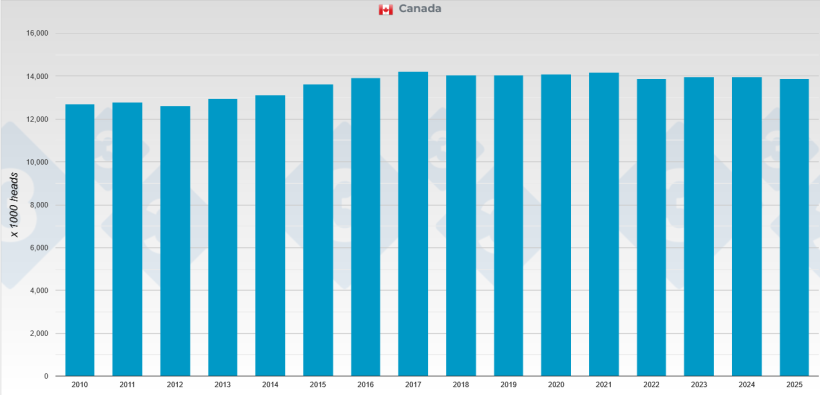
Canada’s swine sector is expected to remain stable in 2026, with production growth driven by improved technical performance rather than herd expansion. Beginning stocks are forecast at around 13.9 million head, with a slight increase in sow numbers supporting output .
Pig crop production is projected to reach 31 million head, representing a 2% year-on-year increase, mainly due to strong sow productivity observed in 2025 . Enhanced biosecurity and farm management have contributed to maintaining low disease pressure. Although a case of porcine epidemic diarrhea virus (PEDv) was reported in early 2026, it appears to be isolated with no further spread .

Hog slaughter is forecast to rise slightly to 22.1 million head, supported by higher utilization of existing processing capacity following industry adjustments in previous years . As a result, pork production is expected to increase by around 1% to 2.17 million metric tons .
Canada will remain a highly export-oriented pork producer, with exports accounting for around 60% of production in recent years. Pork exports are forecast to grow by 2% in 2026, driven by demand in the Indo-Pacific region and new market access opportunities, including Indonesia . In contrast, exports to the United States are expected to decline.
Trade challenges persist, particularly due to the 25% retaliatory tariff imposed by China on Canadian pork, which continues to limit export potential to that market .
Overall, the Canadian swine sector is expected to adopt a cautious strategy in 2026, prioritizing efficiency and productivity while navigating market volatility and strong dependence on international trade.
April 1, 2026 / FAS-USDA/ USA.
https://www.fas.usda.gov