

























 0
0
A brief history of African swine fever in Europe
The disease was first described in Kenya in 1921 and remains endemic in large parts of sub-Saharan Africa. For decades, ASF remained confined to the African continent, reducing the perception of risk outside that region. However, in 1957, the virus left Africa for the first time and was detected in Portugal, marking the beginning of its international spread. Although rapid depopulation initially eradicated the outbreak, the disease reappeared in Spain in the 1960s and was not eradicated until 1995. Subsequently, during the 1970s and 1980s, outbreaks occurred in countries such as Andorra (1975), Belgium (1985), France (1964, 1967, and 1974), Malta (1978), the Netherlands (1986), and Italy (1967, 1969, and 1993), where it was responsible for sporadic outbreaks (Rose and Le Potier, 2020).
A key turning point came in 2007, when ASF was first detected in Eastern Europe, specifically in Georgia. From there, the virus spread across the continent, reaching Spain in November 2025.

The following map shows visually and chronologically the emergence of the first cases of ASF in Europe after its reappearance in 2007 and its geographical evolution over time, allowing us to understand the magnitude and speed of the virus's spread across the continent.
Current ASF situation in Europe
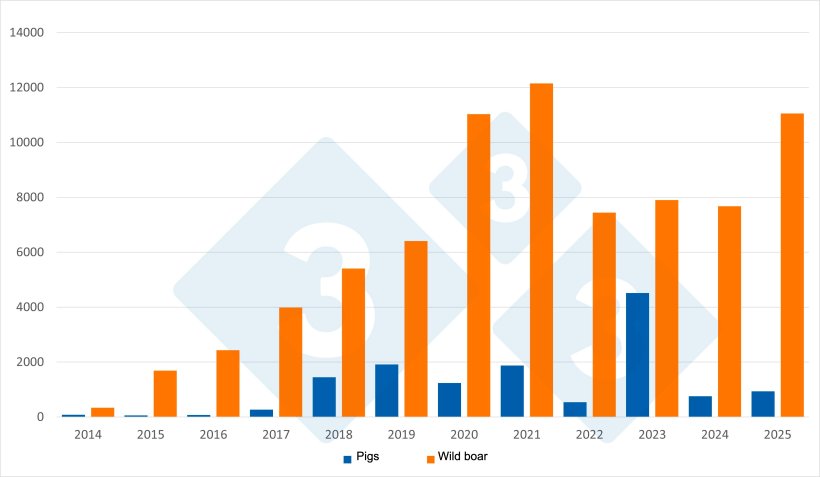
Total number of ASF outbreaks in wild boar and domestic pigs in Europe (excluding Russia). Source: 333 based on ADIS data.
Domestic pigs
In 2025, a total of 937 outbreaks were recorded in domestic pigs, representing a 25% increase compared to 2024 (752 outbreaks), although the figure is well below the historical peaks observed in 2018-2019 and, above all, in 2023, when there were more than 4,500 outbreaks, mainly driven by the emergence of the disease in Croatia, Bosnia and Herzegovina, Serbia, and Romania.
Over the past year, the focus has once again shifted to Eastern Europe and the Balkans, with notable cases in Romania, Serbia, Croatia, Moldova, and Bosnia-Herzegovina, while other countries have shown clear stabilization or declines, such as Germany, which reported no cases in domestic pigs last year after 10 cases in 2024.
Wild boar
The situation in 2025 is particularly significant, with a 44% increase in the number of outbreaks reported in wild boars compared to the previous year (11,054 outbreaks vs. 7,672), making it the second-highest figure in the entire series, behind only 2021, when 12,150 outbreaks were confirmed. Of particular note is the appearance of the disease in Spain at the end of November, with 13 outbreaks confirmed to date, all within the high-risk 6-km radius around the first outbreak in the province of Barcelona.
Outbreaks in wild boars increased in most countries, with the most notable percentage increase in Estonia, where they had gradually declined since the peak in 2016 (1,052) to reach 36 outbreaks in 2024 and then increased again in 2025 (259). The countries that reported the most outbreaks were Poland with 3,351 (an increase of almost 50% compared to 2024) and Germany with 1,992 (+113% compared to 2024), followed by Latvia, Bulgaria, Hungary, Lithuania, and Italy.
January 8, 2026/ 333 Staff with ADIS data.