


























 0
0
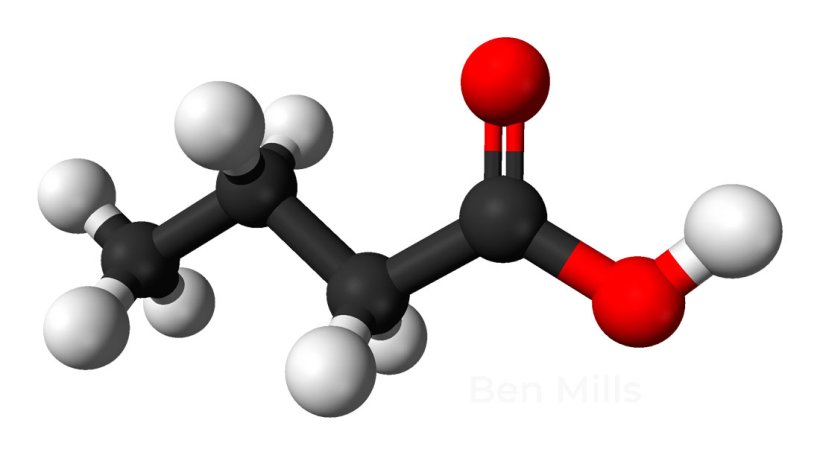
Short-chain fatty acids: butyric acid
Butyric acid is a four-carbon (4C) SCFA that plays essential roles in intestinal homeostasis. Its primary functions include serving as an energy source for intestinal epithelial cells, modulating the inflammatory response, and maintaining the integrity of the intestinal barrier.
Butyric acid is the primary energy source for colonocytes. It is absorbed into the cell via monocarboxylate transporters (MCTs), where it is converted to butyryl-CoA and undergoes mitochondrial β-oxidation, producing acetyl-CoA, which subsequently feeds into the Krebs cycle. In healthy colonocytes, this pathway can meet 70–80% of their energy requirements (Martínez-Ruiz et al., 2025).

In addition, butyric acid increases the expression of tight junction proteins in the intestine, improving the integrity of the intestinal barrier and reducing paracellular permeability. This limits the passage of toxins and microorganisms from the intestinal lumen into the mucosa, thereby decreasing chronic activation of the immune system and reducing the risk of developing digestive pathologies.
A distinctive feature of butyric acid is its ability to act as an epigenetic modulator by inhibiting histone deacetylases (HDACs). This inhibition alters gene expression, promoting the following (Salvi & Cowles, 2021):
- an increase in anti-inflammatory genes,
- a decrease in pro-inflammatory genes,
- and the differentiation and controlled apoptosis of epithelial and immune cells.
Unlike other SCFAs, butyric acid rarely enters the systemic circulation, as it is almost entirely utilized by colonocytes.
Butyric acid is an SCFA that has been extensively studied in swine nutrition, particularly in post-weaning piglets, where it is used as an alternative to antibiotics or zinc oxide to improve gut health and, consequently, production performance.
For inclusion in feed, butyric acid is typically administered in the form of a salt, by adding a cation such as sodium (Na⁺) or calcium (Ca²⁺) to the carboxyl group, resulting in sodium butyrate or calcium butyrate. This salification makes it more stable, less corrosive, and easier to handle. Once in the stomach, the salt rapidly dissociates, releasing the active SCFA.
Butyric acid can be supplied in encapsulated or non-encapsulated form.
Encapsulation, typically using lipid matrices, protects the compound from the acidic gastric pH, digestive enzymes, and oxidation, allowing butyric acid to be released in a more controlled manner in the distal sections of the intestine, where it exerts its most significant physiological effects.
Typical dosing in feed ranges from 0.1% to 0.3% during the pre-starter phase, decreasing to less than 0.1% during the starter phase. There is also the option to administer throughout the 35-42-day post-weaning phase.
The positive effects of butyric acid on intestinal integrity include increased villus height and reduced crypt depth in both the small and large intestines, which are indicators of reduced disruption of the intestinal mucosa. An increase in the expression of genes associated with tight junctions and the mucosal barrier has also been observed, which improves epithelial integrity. All of this translates into improvements in gut health, growth, and feed efficiency compared to piglets that do not receive SCFAs in their feeding programs (Hanczakowska et al., 2014; Liu et al., 2023; Maito et al., 2022). Likewise, a reduced incidence of diarrhea and an increase in beneficial microbial populations have been reported. However, it is important to note that the effects on growth and gastrointestinal health may vary depending on the animal’s age, the dose, and the type of acid encapsulation, and not all studies have shown significant improvements (Maito et al., 2022; Rakytianskyi et al., 2025).
Medium-chain fatty acids: lauric acid, caprylic acid, capric acid
Several studies have shown that supplementation with MCFAs can improve weight gain in piglets during the nursery phase, especially during the first few weeks after weaning.
MCFAs, particularly caprylic acid (C8) and capric acid (C10), are notable for their rapid absorption and oxidation in the liver, providing an immediate energy source at a stage when the digestion of long-chain fats is still limited. This effect translates into significant improvements in piglet growth during the nursery phase, with increases of 18.7% for C8 (caprylic acid), 13.0% for C10 (capric acid), and 15.8% for the C8+C10 combination, according to results obtained by Hanczakowska et al. (2011). Other studies show more moderate benefits, with 2-3% increases in growth when various MCFAs are combined (C6 caproic acid - C12 lauric acid) and improvements of 7-11% with the dietary inclusion of medium-chain triglycerides in early periods (1-21 days post-weaning), demonstrating that their efficacy is greater when administered in the initial phases and in more concentrated forms.
Together these results suggest that MCFAs can help promote early growth in post-weaning piglets due to their high energy availability, antibacterial activity, and ability to support metabolism in immature animals.
Recent findings
1. A blend of medium-chain fatty acids, butyrate, organic acids, and a phenolic compound accelerates microbial maturation in newly weaned piglets.
The objective of the study was to evaluate the effects of MCOA, a feed additive composed of medium-chain fatty acids, organic acids, slow-release C12, butyric acid, and a phenolic compound, on the gut microbiota and metabolome in post-weaning piglets (PW). Diets containing and not containing 0.2% of this additive were compared. The supplemented piglets gained 40 g/day more than the control group piglets during the first 13 days PW, with no differences in feed intake. At 7 days PW, the supplemented piglets showed improved body metabolism, expressed as a significant reduction in creatine, creatinine, and β-hydroxybutyrate—indicators of improved energy balance and muscle metabolism—along with reduced mobilization of body fat. Changes in metabolites associated with bile acids were also detected, such as a reduction in the abundance of taurine (a bile acid precursor) and an increase in cholic acid, suggesting greater production and secretion of bile acids induced by MCOA during the first 14 days PW. At the microbiota level, a trend toward an increase in the Lactobacillus population was observed on day 7 post-weaning with the inclusion of the additive. In conclusion, MCOA may promote tissue metabolism and microbiota reconfiguration by modulating the production and secretion of bile acids.
2. Specialized Feed-Additive Blends of Short- and Medium-Chain Fatty Acids Improve Sow and Pig Performance During Nursery and Post-Weaning Phase.
The objective of the study was to evaluate the effect of dietary supplementation with a synergistic mixture of SCFA and MCFA—comprising sorbic acid, formic acid, acetic acid, lactic acid, propionic acid, and a mixture of C8–C12 MCFA—at a concentration of 3 kg/ton during the peripartum and lactation periods on the growth and health of the litters. The study was conducted with a total of 72 sows and their litters, with subsequent monitoring of growth and microbiological counts in 528 piglets during the post-weaning period. Supplementation reduced backfat loss in sows throughout lactation and increased the average weight of weaned piglets and intra-litter uniformity at weaning. In addition, positive changes were observed in the microbiota of nursing piglets, with an increase in lactic acid bacteria and a reduction in Streptococcus suis. Although there was no effect on post-weaning growth, bacterial modulation persisted and feed efficiency improved. In conclusion, maternal supplementation with SCFA-MCFA reduced the mobilization of body fat in sows throughout lactation and promoted growth and improved the microbiota of piglets during lactation.
3. Microencapsulated medium-chain fatty acids as an antibiotic alternative improve intestinal immunity and microbiota composition in weaned piglets
The objective of this study was to evaluate how supplementation with microencapsulated MCFA (C8 caprylic acid and C10 capric acid) affects growth, antioxidant capacity, immune response, and gut microbiota in newly weaned piglets. A total of 120 weaned piglets (mean initial weight of 6.38 kg) were randomly assigned to three groups for 42 days: a control group fed a basal diet of corn and soybean, a group fed the same diet supplemented with colistin (a growth-promoting antibiotic), and a third group fed the diet supplemented with 0.15% microencapsulated MCFA. Each treatment group consisted of 5 replicates of 8 animals per pen. The piglets that received MCFA consumed more feed throughout the trial than the other two groups. In addition, during the first two weeks after weaning, they had fewer episodes of diarrhea than the group treated with antibiotics. At the end of the study (day 42), the animals supplemented with MCFA showed higher antioxidant capacity in the blood and lower levels of pro-inflammatory molecules in the intestine. An increase in the production of short-chain fatty acids (such as butyric acid) in the intestine was also observed; these compounds are beneficial for gut health. Microbiota analysis revealed that MCFA positively altered the bacterial composition, promoting the growth of bacteria considered beneficial, such as Rikenellaceae_RC9_gut_group and Roseburia. Supplementation with 0.15% microencapsulated MCFA improved feed intake, promoted a more balanced gut microbiota, and reduced intestinal inflammation in weaned piglets, positioning it as an interesting alternative to the use of antibiotics during this critical stage.
4. Dietary fatty acids promote gut health in weaned piglets by regulating gut microbiota and immune function
This study evaluated whether two different combinations of MCFA and SCFA could replace zinc oxide (ZnO) in recently weaned piglets. A total of 108 piglets (mean weight 8.22 kg) were divided into three groups: a basal diet with ZnO (con), a basal diet with a higher proportion of MCFAs and a lower proportion of SCFAs (VSM, MCFA:SCFA ratio = 1.5:1), and a basal diet with a higher proportion of SCFAs and a lower proportion of MCFAs (VS + VM, ratio MCFA:SCFA = 0.8:1). The MCFAs included were caprylic, capric, and lauric acids, while the SCFAs were formic, acetic, and propionic acids. Both combinations (VSM and VS + VM) achieved results similar to ZnO in controlling diarrhea during the first 15 days post-weaning. A higher average daily gain and improved feed efficiency were observed during the initial phase, with no differences in final weight compared to the control group. Furthermore, supplementation with MCFA and SCFA reduced oxidative stress (lower MDA activity and higher total antioxidant capacity), decreased the production of pro-inflammatory cytokines (TNF-α, IL-1β, IL-17A), and was associated with a modulation of the inflammatory response. Likewise, both combinations increased the abundance of beneficial bacteria such as Lactobacillus and Roseburia. Between the two formulations, VSM showed slightly superior effects, especially in the anti-inflammatory profile. Between the two formulations, VSM showed slightly superior effects. The combination of MCFA and SCFA may be an effective alternative to zinc oxide in weaned piglets, as it reduces diarrhea, improves antioxidant balance, modulates inflammation, and promotes a healthier gut microbiota.