

























 0
0
Modern swine production faces increasingly complex challenges in maintaining health and productive balance. Even with targeted interventions directed at specific pathogens, it is common to observe batches with below-expected or persistent disease outbreaks. This raises an important question: are we evaluating all the factors involved in animal health?
Among the elements that are often overlooked is the microbiota (a true "invisible organ"), which plays a key role in the health, immunity, and productivity of pigs. Understanding its dynamics and how it can become imbalanced is increasingly essential for the success of health and nutrition programs (Wang et al., 2025).

Microbiota vs Microbiome
The microbiota refers to the community of microorganisms inhabiting a specific site within the host, such as the intestine, respiratory tract, or skin. These microorganisms interact with each other and with the host, creating a highly dynamic system.
With the advancement of next-generation sequencing (NGS) technologies, research has expanded beyond identifying which microorganisms are present to understanding what they do. This led to the concept of microbiome, which considers the pool of genomes and their metabolic functions (Berg et al., 2020), allowing for a deeper understanding of their impact on host physiology and immune response.
The microbiota is not static: it adapts and evolves
Microbial colonization in pigs begins even during intrauterine life,, intensifying at birth and during early contact with the environment. The initial composition of the microbiota directly influences immune development, feed efficiency, and resistance to infections through life (Liu et al., 2023; Monteiro et al., 2022).
However, the microbiota is not static. It continuously adapts in response to physiological, nutritional, environmental, and management-related factors. This plasticity determines the animal's ability to maintain the balance between health and disease (Luo et al., 2022).
Eubiosis and dysbiosis: two sides of the same ecosystem
Eubiosis represents the functional balance of the microbiota, in which beneficial microorganisms coexists in harmony, contributing to host protection and the maintenance of physiological homeostasis.
In contrast, dysbiosis is characterized by the loss of this balance, which may result from reduced microbial diversity, shifts in relative abundance, or loss of protective functionality.
Dysbiosis is often triggered by environmental or physiological disturbances associated with stressors such as:
- Abrupt dietary transitions
- Early weaning
- Heat stress
- Co-infections
- Inappropriate use of antimicrobials
Beyond the loss of microbial diversity, dysbiosis involves the reduction in the protective functionality of the microbiota, creating favorable conditions for the proliferation of opportunistic pathogens and the development of chronic inflammatory processes.
In this way, animals experiencing dysbiosis become more susceptible to infections, show reduced productive performance, and have higher incidence of enteric and systemic diseases (Tang et al., 2025). Maintaining eubiosis is therefore essential to preserving one of the animal's primary natural defenses against disease.
How does microbiota protect against disease?
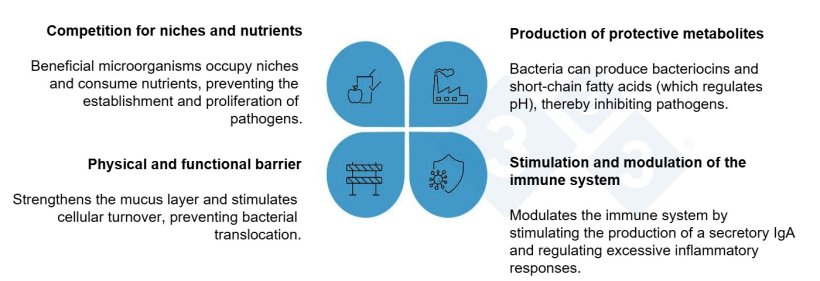
A healthy microbiota act as natural barrier through different mechanisms:
In practice, what factors affect the microbiota?
Multiple factors interfere with the composition and stability of the swine microbiota. Among them, diet quality, management, and environment directly influence microbial balance (Tang et al., 2025).
|
|
Nutrition Diets with excess undigested protein, low fermentable fiber content, or abrupt transition during weaning can lead to proteolytic fermentation and the production of toxic metabolites. Inappropriate use of feed additives can also compromise eubiosis. |
|
|
Management and environment Thermal, social, and handling stress increase cortisol and alter immunomodulation and microbial balance. Poor hygiene conditions and low water quality contribute to pathogen load. |
 |
Physiological and genetic factors Age, genetics, and the presence of immunosuppressive infections (viral or bacterial) directly modulate microbial composition and susceptibility to disease. |


Antimicrobials: impacts on the microbiota and dysbiosis
Among the most significant factors in the induction of dysbiosis is the inappropriate use of antimicrobials (AMs). Although they are essential for the treatment of infections, their continuous and indiscriminate use has negative implications for animal health and production sustainability (Upadhaya y Kim, 2022).
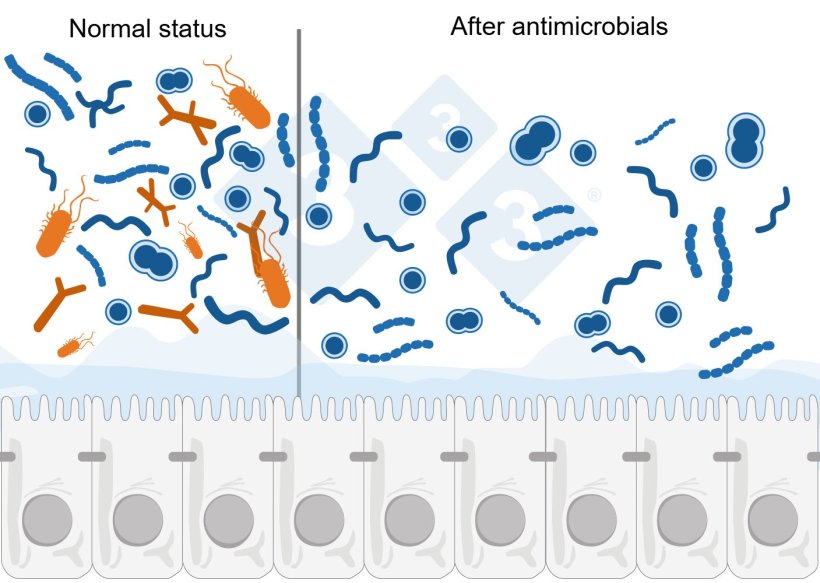
The mechanism of action of antimicrobials, aimed at eliminating pathogens, also directly affects the microbiota and its balance.
|
Reduction of diversity and loss of function Antimicrobials, specially broad-spectrum, drastically reduce microbial diversity and disrupt microbial balance, compromising the function of the microbiota. |
Resistance selection Inappropriate antimicrobial use selects for resistant bacteria, eliminating susceptible populations and allowing resistant strains to proliferate and cause infections or outbreaks after treatment. |
Loss of resilience Following antimicrobial treatment, the microbiota loses diversity and functionality, reducing its capacity to recover. This decreased resilience increases susceptibility to dysbiosis, recurrent infections, and long-term relapse. |
Adapted from Seekatz AM et al, 2022
The challenge of antimicrobial restriction and its alternatives
At the global level, there is an increasing trend on the restrictions on antimicrobial usage in animal production, driven by concerns about antimicrobial resistance (AMR), one of the major public health challenges worldwide.
Restricting antimicrobial use should not be interpreted as a therapeutic gap or a lack of alternatives, but rather as a need for new health management strategies. The veterinarian's approach must shift from treatment to proactive prevention, prioritizing microbiota modulation, promotion of eubiosis and strengthening of resilience as key pillars for sustainable health and production.
Currently, the industry offers a range of safe and effective alternatives, highlighting:
|
Probiotics Beneficial microorganisms (e.g., Lactobacillus, Bacillus) that compete with pathogens, enhance immunity, and balance the microbiota, particularly useful at weaning. |
|
Prebiotics Functional fibers (e.g., FOS, MOS, inulin) that stimulate the growth of beneficial bacteria and increase short-chain acid (SCFA) production, essential for intestinal integrity. |
|
Organic acids Reduce gastric and intestinal pH inhibiting E. coli and Salmonella, while improving digestion and enteric control. |
|
Antimicrobial peptides (AMPs) Molecules with direct activity against pathogens and minimal impact on commensal microbiota, with potential immunomodulatory effects. |
|
Phytochemicals and plant extracts Natural compounds with anti-inflammatory, antioxidant, and selective antimicrobial properties that support gut health and productive performance. |
Conclusions
The relationship between microbiota, dysbiosis, and disease is multifactorial and requires an integrated approach involving nutrition, management, environment, and rational antimicrobial use. Incorporating the concept of microbial health into production strategies is an essential step towards a more sustainable, productive swine industry and align with the One Health principles.