


























 0
0
Studying the genome of the African swine fever (ASF) virus is like trying to read a manuscript that is thousands of pages long, written in an unknown language, about which there is still incomplete information. This pathogen, responsible for a devastating viral disease affecting domestic pigs and wild boars, is now one of the greatest threats to pig farming worldwide. Yet, despite decades of research, its genome is far from fully decoded.
An “off-the-charts” virus
The first obstacle in studying the virus is the size and complexity of its genome. With its size ranging between 170 and 193 kilobases, the ASF virus has the largest known genome among DNA viruses that infect animals. It contains over 150 genes, many of which have functions that are still unknown or difficult to interpret.

By comparison, the influenza virus—which has been studied much more extensively—has only eight genomic segments and just over a dozen proteins.
This enormous genetic complexity is not just a biological curiosity: it represents a real technological challenge. Repeated regions, duplicated genes, and structural variations make complete and accurate sequencing difficult.
Few sequences, many unknowns
Further complicating matters is the scarcity of complete genomes shared in international databases. Despite the global spread of the virus, only a limited number of sequences are available. This limits the ability to compare strains, understand their evolution, and identify key mutations related to virulence or transmissibility.
The reasons for this scarcity are mainly technical and logistical, but there is also a lack of collaborative awareness among countries. Manipulation of the ASF virus requires high-security laboratories (BSL-3), and only a few centers are equipped to perform complete genomic analyses. Furthermore, sequencing such a large genome involves significantly higher costs and time than for other viruses.
Italy's case: A natural laboratory
A fundamental contribution to our knowledge of the ASF virus has recently come from Italy. The study “Molecular characterization of the first African swine fever virus genotype II strains identified from mainland Italy” (Giammarioli et al., 2023) provided the first molecular characterization of genotype II strains identified on the peninsula, revealing their close relationship with those widespread in Eastern Europe.
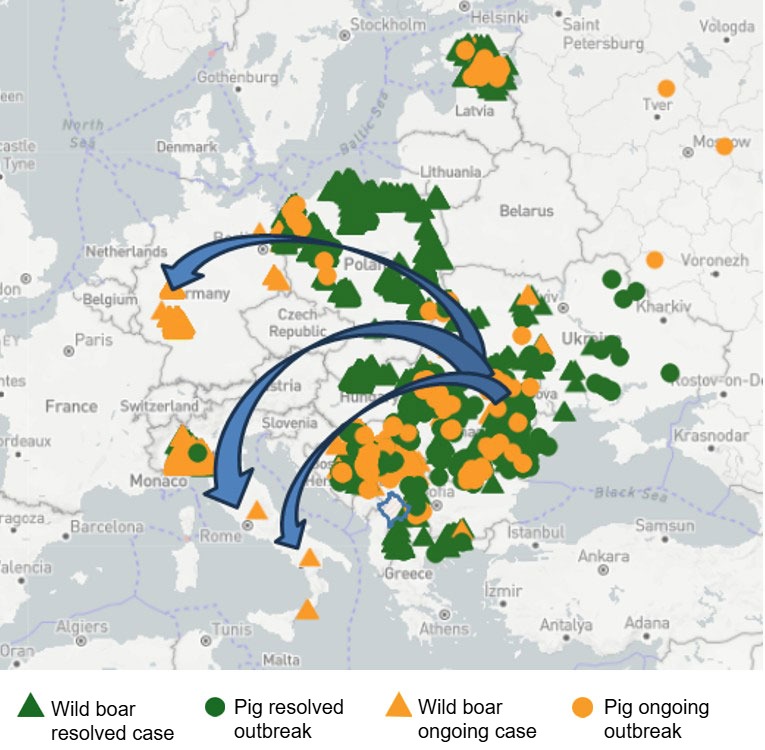
Subsequently, another paper published in 2025, “Genome-wide approach identifies natural large-fragment deletion in ASFV strains circulating in Italy during 2023” (Torresi et al., 2025), identified large natural deletions in certain viral strains. These mutations, which involve the loss of entire portions of the genome, could influence the virulence or ability of the virus to evade the immune response, but their biological significance remains to be elucidated.
Genotypes, serotypes, and global spread
The ASF virus is classified into at least 24 distinct genotypes, based on the sequence of the B646L gene (which codes for the p72 protein), and almost as many serotypes, the 8 most common being determined by the variability of the CD2v protein (EP402R). However, the correlation between genotype, serotype, and virulence is not yet well understood: viruses within the same genotype can have different epidemiological behaviors.
A recent phylogenetic study, “A phylogenetic contribution to understanding the panzootic spread of African swine fever: from the global to the local scale” (Rossi et al., 2025), has made a decisive contribution to clarifying the mechanisms of virus spread on a global and local scale, highlighting how small evolutionary events and point mutations can influence the geography of epidemics. This type of phylogenetic approach is crucial for tracing the “phylogeographic history” of the virus and interpreting its routes of spread.
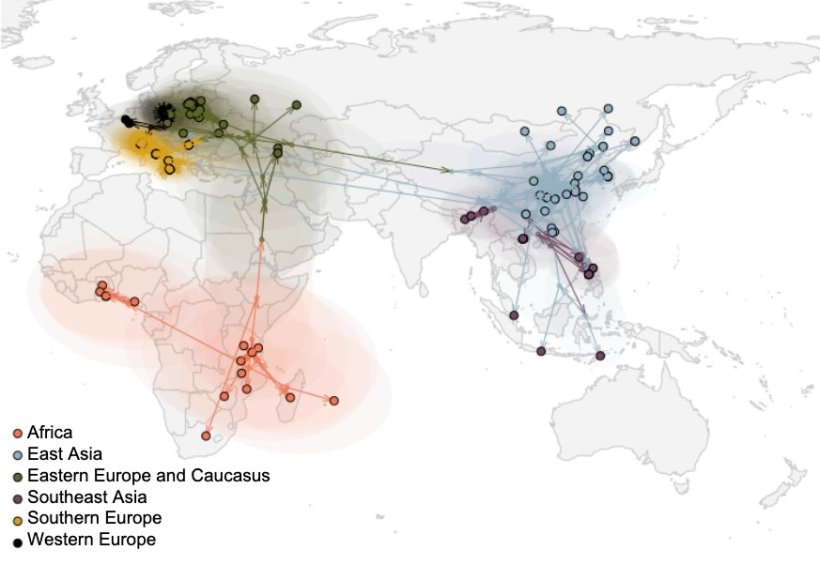
Figure 2. Global spread of the ASF virus (Rossi et al. bioRxiv 2025).
New technologies, a puzzle to be pieced together
Today, new sequencing platforms and advanced bioinformatics tools are opening up unprecedented prospects. Long-read sequencing techniques allow very long stretches of DNA to be read, reducing errors in repeated regions. At the same time, integration with proteomic and structural data could help decipher the function of the many genes that are still “orphans of meaning.”
However, as long as complete genomes remain scarce and international scientific cooperation is limited, the African swine fever virus will continue to be, genetically speaking, a giant shrouded in mystery.
