























 0
0
The Health and Biotechnology Research Group at the Institute for Game and Wildlife Research (IREC – CSIC, UCLM, JCCM), together with the European consortium ENETWILD, has launched the first high-resolution European map of wild boar density. This scientific breakthrough, published in 2024, marks a milestone in wild boar population management and the control of diseases such as African swine fever (ASF).
Until recently, managing this problem faced a technical obstacle: data on wild boar abundance in Europe was fragmented, as each country used different methods to count its populations. This lack of harmonization prevented scientists and policy and management makers from having a comprehensive and accurate overview to act in a coordinated, efficient, and effective manner in response to epidemics.

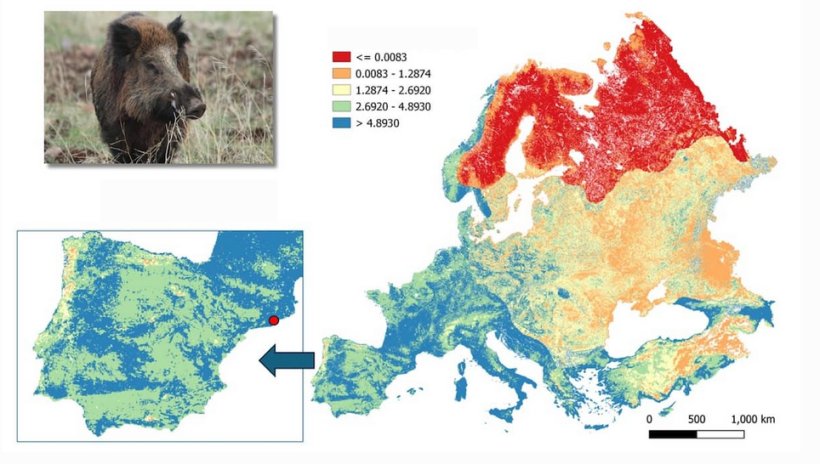
Through unprecedented international cooperation, a Europe-wide wild boar density map with a spatial resolution of 2×2 km has been created, providing an accurate and comparative overview of wild boar populations across Europe. This map is an essential tool for surveillance, disease modeling, and control measure planning.
The results, which are already available as a preprint and will be published in the European Journal of Wildlife Research, indicate a total wild boar population in Europe of between 13.5 and 19.6 million individuals before the annual hunting season in the main distribution area of the wild boar, prior to the outbreak of African swine fever (ASF). The estimated wild boar population in Spain exceeds 2.4 million individuals, with more than 200,000 in Catalonia.
The map reveals that, despite hunting efforts, wild boar populations in Europe have continued to grow, especially in the high-density “Mediterranean corridor,” which stretches from southern France and Catalonia to southeastern Spain. These areas coincide with high concentrations of domestic pigs and major transportation routes, increasing the risk of ASF spread.
This scientific advancement not only improves wildlife management, but also provides a disease monitoring system with direct applications in epidemiological modeling and risk analysis, marking an important step in scientific cooperation to address transnational biological problems.
December 23, 2025/ IREC/ Spain.
https://www.irec.es/