

























 0
0
In the west of the Brazilian state of Paraná, one of the country's highest pig-producing regions, increased pig production has brought a proportional challenge: the management and proper valorization of manure.
The high concentration of farms and the lack of available land for proper manure application limited industry expansion in the area. In this context, the Primato Agro-industrial Cooperative, in collaboration with MWM, a subsidiary of Tupy, developed the Suíno Verde (Green Pig) project.

On finishing farms, animals can generate between 3 and 15 liters of manure per day, depending on their weight - going from approximately 23 kg at the beginning to 130 kg at the end - in an average cycle of 100 days. On the other hand, sows, which maintain a more constant weight, produce around 30 liters per animal per day. On farms with thousands of heads, this volume represents a significant environmental liability.
From the farm to the biogas plant: A circular cycle
The cooperative currently has 170 integrated farms, of which 28 are sow farms, 13 are nurseries, and 129 are finishing. For the project, however, the manure is collected in 23 units.
The process begins with collecting manure from the farms. The plant manages the operations, organizing weekly removals according to the animal production stage. For piglets, loads must be collected every two days, and daily collections are made during the finishing phase. The average collection distance from the biogas plant is 10 km, although it can reach up to a 22-km radius.
The maure collection trucks are fueled by the biomethane generated in the process, which significantly reduces costs compared to using diesel.
At the biogas plant, located in Ouro Verde do Oeste, the manure undergoes an initial liquid/solid separation stage before being sent to the biodigesters. There, anaerobic digestion takes place—a biological process in which microorganisms break down organic matter in the absence of oxygen—resulting in the production of biogas, composed mainly of methane (CH₄) and carbon dioxide (CO₂).
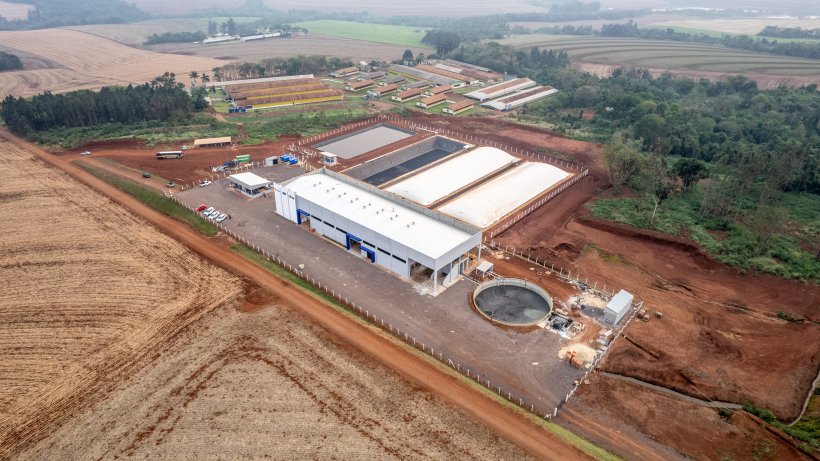
Primato biogas plant located in Ouro Verde do Oeste (Paraná, Brazil).
The biogas is captured and piped to the purification plant. Part of it is used to generate electricity and heat. Another fraction undergoes a refining process that removes CO₂ and increases the methane concentration, resulting in biomethane, which is used to fuel the Green Fleet trucks—currently, two are used for manure collection and three for feed distribution.
The separated CO₂ is also utilized, primarily by the meat industry for stunning animals prior to slaughter, and by the chemical industry for urea production. Meanwhile, the digestate, the fraction resulting from anaerobic digestion, is transformed into a biofertilizer, applied to crops such as corn, soybeans, and wheat.
These inputs return essential nutrients to the soil in a balanced way, reducing dependence on mineral fertilizers and improving resource use efficiency.
Environmental and economic results
With the implementation of the Suíno Verde project and the possibility of removing and treating manure, the environmental authorities began authorizing a gradual increase in the pig inventory, unlocking growth in the sector across the region.
In transportation, replacing diesel with biomethane reduces CO₂ emissions by an average of up to 62 tonnes per truck per year. With a fleet of 10 vehicles, the mitigation potential exceeds 490 tonnes annually. In addition to the environmental benefits, using this renewable fuel generates direct savings, reducing operating costs by up to 40%.
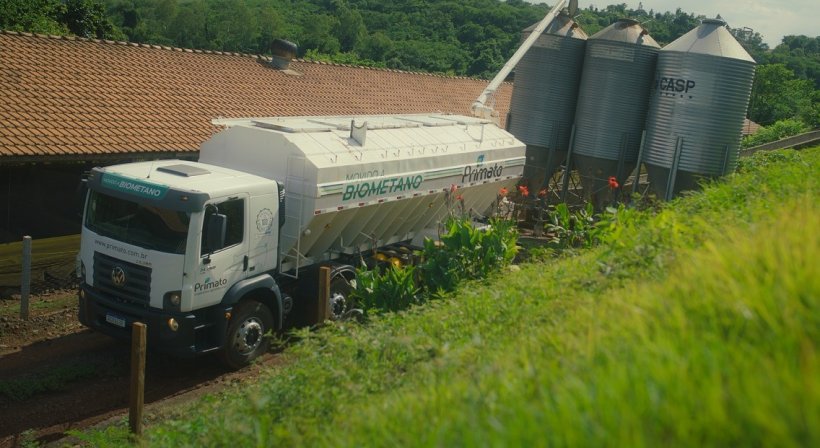
Feed delivery truck powered by biomethane produced at the biogas plant as part of the Suíno Verde project.
On agricultural land, the use of organic fertilizers has improved soil structure and fertility, increasing crop yields and reducing dependence on synthetic fertilizers.
On the other hand, anaerobic digestion eliminates bad odors and drastically reduces the presence of insects and pathogens.
All these advances make the industry more attractive to new generations of producers.
The cooperative as an engine of sustainability
The Suíno Verde project goes beyond technological innovation: it consolidates a cooperative circular economy model. The integration of producers, industry, and the cooperative creates a continuous cycle of manure valorization and shared distribution of the resulting benefits. This collective structure makes it possible to undertake investments and ensure that the benefits remain within the region.
The technology has been adapted to the characteristics of regional pig production, prioritizing simplicity, safety, and energy efficiency. Primato is responsible for organizing the collection, transport, and final destination logistics, ensuring the economic sustainability of the process. The balance between innovation and cooperation makes this model replicable in other regions, strengthening the integration between bioenergy and animal production.
Clean energy and remaining in rural areas
Looking ahead to the project's expansion, Primato plans to build two new biogas production plants by 2027. With facilities located every 20 km, the maximum collection distance would be reduced to approximately 10 km per plant, lowering logistics costs and improving efficiency. The model stipulates that the collection cost will continue to be shared equally among the three stakeholders—Primato, the plant, and the pig producer—with each contributing 33%. The new units will operate entirely on biogas, strengthening energy independence and accelerating the industry's decarbonization.
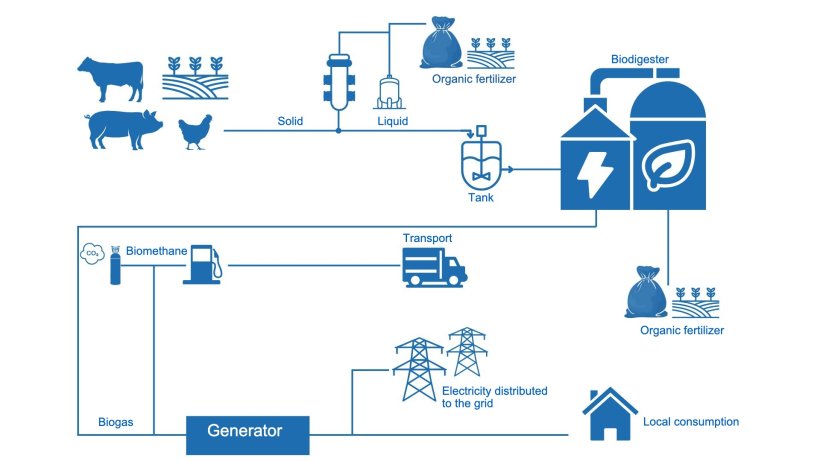
Process of generating biogas, organic fertilizer, and energy from manure.