
























 0
0

Consider the humble piggybank. For most people, it’s little more than a decorative keepsake. But for those in the swine industry, it can be a powerful symbol: when you break it, you get out of it only what you’ve put in. The same holds true for real pigs. When we market them, the return reflects every ounce of time, effort, and investment that went into their growth. Real pigs are just like piggybanks, and that comparison offers more insight than first meets the eye.
One of the inevitable realities of swine production is that markets eventually turn against us. Prices fall, profit margins vanish, and the pressure to cut costs becomes nearly irresistible.

Cost-cutting feels like control; it’s tangible and delivers immediate results. Yet the danger is that, unless what’s being cut is truly waste, each reduction removes something that contributed to productivity and output.
In trying to save money, we may be withdrawing more from our “piggybank” than we can afford, ultimately undermining long-term profitability for short-term relief.
This is where the lesson of the piggybank becomes essential. When we put money aside, we do so during good times so that it’s available when we need it most. Similarly, if we want greater economic resilience in the face of hard times, our focus should shift from cutting costs to outproducing the challenges ahead. Profitability in the future depends on what we invest today.
Historically, the major leaps in agricultural progress have come not from relentless cost-cutting, but from strategic investment, the willingness to put more into the “piggybank.” For much of the modern era, the most obvious investment pathway was through economies of scale. Larger farms, vertical integration, and improved access to global markets allowed producers to raise more pigs at a lower cost per head. This investment in efficiency built the foundation for resilience, enabling producers to weather downturns and capitalize on new opportunities when markets recovered.
However, in much of the swine-producing world, the marginal gains from scale are beginning to level off. Many operations are already operating near technical and logistical limits. This reality invites a new question: Where should the next wave of investment be directed to sustain profitability and resilience?
The emerging answer is precision production
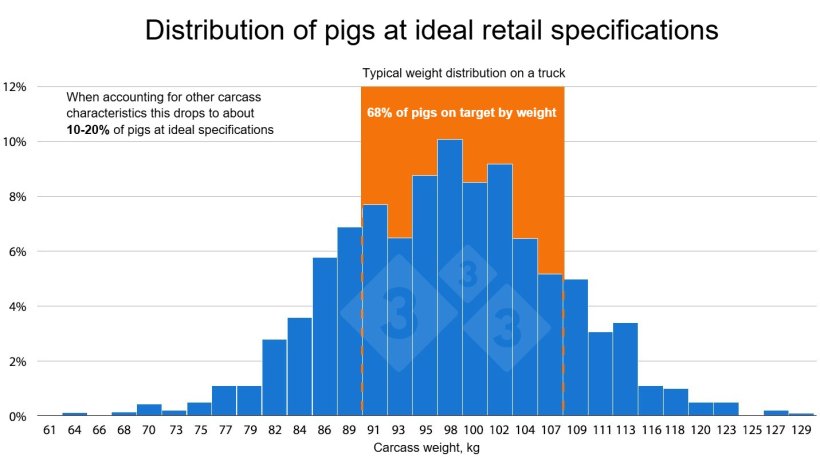
Traditional group-based production models rely on averages. Feed formulations, health protocols, and management practices are optimized for the “average pig.” Yet, as every producer knows, few pigs are truly average. Some need more, others less. The result is a population with wide variation in growth rates, body composition, and carcass characteristics. This variation creates downstream challenges for processors and buyers, who must handle pigs that differ in ways they didn’t plan for or desire (Figure 1).
Precision production represents a shift from managing populations to managing individuals. Its goal is simple but profound: to ensure that each pig produced is the pig intended.
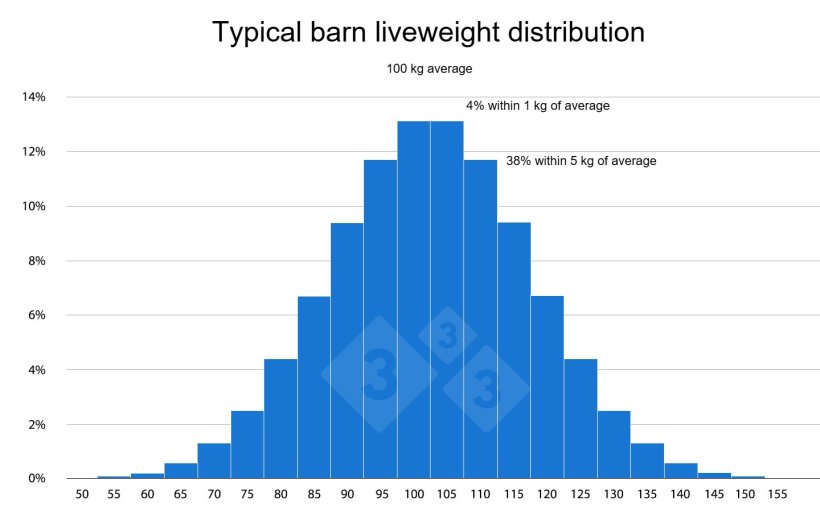
By tailoring management to individual needs, we can better direct resources (feed, health interventions, environmental adjustments) only where they are needed to achieve the desired outcome (Figure 2). In essence, precision production is about investing smarter, not simply spending more.
Crop producers have already demonstrated the power of this approach. Precision agriculture technologies, variable rate application, soil mapping, and yield monitoring, have driven dramatic improvements in both efficiency and output. Swine production systems now stand at the threshold of a similar transformation. The ability to identify, measure, and respond to individual variation within herds will define the next generation of profitability in production.
The first investment in precision production is the ability to measure variation
Before we can manage pigs as individuals, we must first recognize them as such in our data. Metrics such as standard deviation describe how much individual pigs differ from the group average.
Measures of skewness or quartiles reveal whether pigs are distributed evenly or clustered toward one end of the performance spectrum. And never underestimate the power of visualization: charts, graphs, and data dashboards can make patterns visible that numbers alone may obscure. The human eye is, after all, a remarkable tool for detecting trends and outliers.
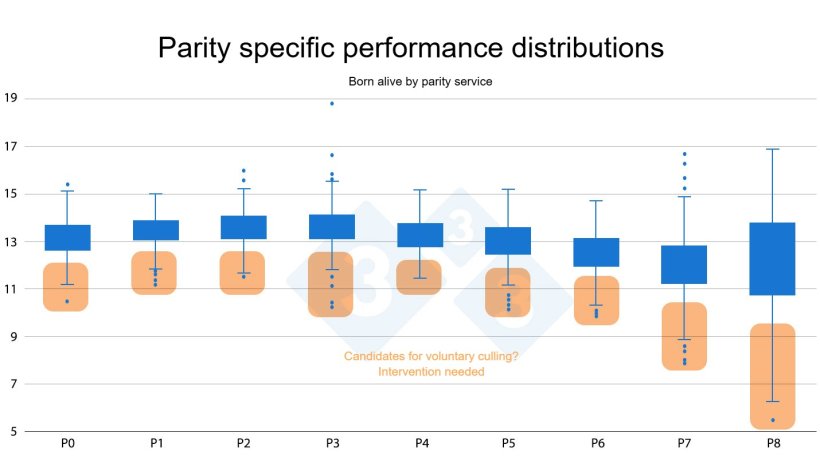
Once variation is measured, opportunities begin to emerge. Low-performing sows can be identified for intervention or culling (Figure 3). We can pinpoint the traits that make certain gilts exceptionally productive.
Marketing strategies can be refined to group more uniform pigs for sale. Subclinical disease impacts can be detected earlier, before they erode herd performance. Each of these advances stems from the same investment: improving our ability to measure and understand variation.
Ultimately, the Piggybank Principle reminds us that resilience and profitability are built over time through consistent, thoughtful contributions. Cutting back may offer temporary relief, but long-term success comes from the willingness to invest. Precision production offers a new way to make those contributions count, ensuring that every resource put into the pig results in measurable value coming back out.
As we look toward the future of swine production, the piggybank remains a fitting symbol. What we build into our systems today determines what we can draw upon tomorrow. In Part 2, we’ll explore how the magnitude of these investments can reshape profitability across the entire production chain.
Watch the free webinar “Precision Production of Pigs – Unlocking Profitability Through Managing Variation” to learn more about actionable strategies to reduce variation, improve carcass value, and enhance overall farm profitability.