

























 0
0
In any business, profitability is the reward for good decisions made over time. In swine production, however, that relationship is more complex. Profitability is not just the difference between cost and price; it’s the reflection of how well we convert biological potential into economic value. The more efficiently we turn inputs into consistent, high-quality outputs, the more resilient and profitable the system becomes.
In part 1 of this series, we introduced the Piggybank Principle: what you get out of pigs is directly tied to what you put in. Cost-cutting alone is rarely a sustainable path to profit. Success depends on targeted investments that make production systems more precise, predictable, and resilient.

Profitability as a system, not a snapshot
Traditional accounting often looks at profit as a snapshot in time: revenue minus cost. But in biological systems like swine production, profit is best understood as a flow, the cumulative effect of many small efficiencies, risks avoided, and opportunities captured across time.
For example:
- A single percentage point improvement in growth rates may seem small, but in a 10,000-head system, it compounds over time.
- Reducing variability among finishing pigs by just a few kilograms can create major savings in sorting, marketing, and processing.
When these improvements are viewed together, they form a systemic investment return, a pattern of gains that strengthens both the bottom line and the business’s resilience to shocks.
Precision production as an investment class
Precision production reframes biological variation as an economic variable, something to be measured, modeled, and managed. It involves allocating capital not just to inputs like feed or facilities, but to information, the foundation of precision.
The core investments typically fall into three categories:
- Measurement technologies: Sensors, cameras, and scales that automatically track growth, environmental conditions, and input usage.
- Data infrastructure: Systems that integrate and interpret information across production phases up to final slaughter results.
- Decision algorithms: Predictive tools and models that guide real-time interventions and optimize resource use.
Special attention should be paid to data infrastructure as this category is one that most farms can begin investing in immediately. In particular, slaughter data can provide an unprecedented view of pigs on an individual level. Connecting it to other readily available datasets can provide immediate and actionable insights.
When evaluated through an economic framework, these investments deliver three forms of return:
- Efficiency gains, by aligning inputs more precisely with each animal’s needs.
- Consistency gains, by reducing variation and improving predictability across production flows.
- Resilience gains, by creating systems that detect and correct problems before they cascade into losses.
While each return can be quantified separately, their combined effect is often multiplicative rather than additive, each improvement strengthens the impact of the others.
For instance, better health monitoring (a resilience gain) amplifies the value of feed optimization (an efficiency gain) because healthier pigs convert feed more predictably and with less variability (a consistency gain).
The value of reduced variation
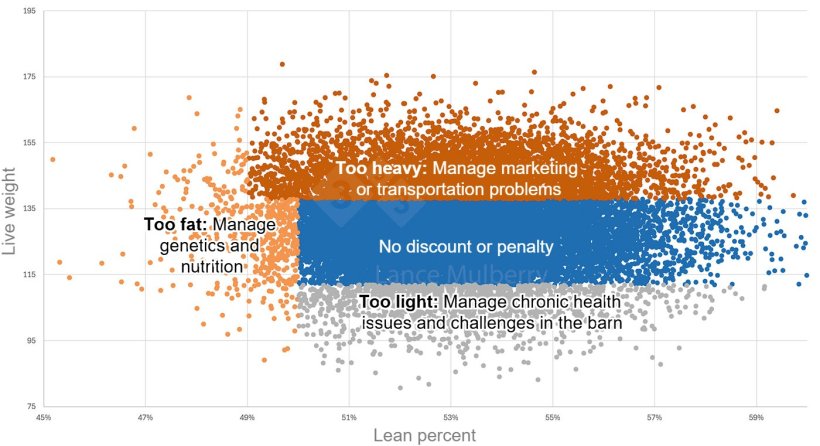
Few factors erode profitability more quietly than uncontrolled variation. Every deviation from target weight or carcass composition translates to lost value. Processors prefer uniformity because it simplifies their production and enhances product consistency; consumers prefer it because it delivers predictable eating quality.
From an economic standpoint, reducing variation improves profitability in three ways:
1. Market alignment: More pigs meeting specification means fewer penalties.
Figure 2: Example of a European packer matrix with premiums and penalties to base price determined by weight and lean percentage.
| Carcass weight (kg) | ||||||||||
|---|---|---|---|---|---|---|---|---|---|---|
| Lean % | <75 | 76 | 78 | 84 | 108 | 109 | 110 | 111 | 112 | >125 |
| <45 | -0.26 | -0.23 | -0.21 | -0.19 | -0.17 | -0.19 | -0.20 | -0.21 | -0.22 | -0.37 |
| 45 | -0.26 | -0.23 | -0.21 | -0.19 | -0.17 | -0.19 | -0.20 | -0.21 | -0.22 | -0.37 |
| 46 | -0.26 | -0.23 | -0.21 | -0.19 | -0.17 | -0.19 | -0.20 | -0.21 | -0.22 | -0.37 |
| 47 | -0.26 | -0.23 | -0.21 | -0.19 | -0.17 | -0.19 | -0.20 | -0.21 | -0.22 | -0.37 |
| 48 | -0.26 | -0.23 | -0.21 | -0.19 | -0.17 | -0.19 | -0.20 | -0.21 | -0.22 | -0.37 |
| 49 | -0.26 | -0.23 | -0.21 | -0.19 | -0.17 | -0.19 | -0.20 | -0.21 | -0.22 | -0.37 |
| 50 | -0.26 | -0.23 | -0.21 | -0.19 | -0.17 | -0.19 | -0.20 | -0.21 | -0.22 | -0.37 |
| 51 | -0.22 | -0.19 | -0.17 | -0.15 | -0.13 | -0.15 | -0.16 | -0.17 | -0.18 | -0.33 |
| 52 | -0.18 | -0.15 | -0.13 | -0.11 | -0.09 | -0.11 | -0.12 | -0.13 | -0.14 | -0.29 |
| 53 | -0.16 | -0.13 | -0.11 | -0.09 | -0.07 | -0.09 | -0.10 | -0.11 | -0.12 | -0.27 |
| 54 | -0.13 | -0.10 | -0.08 | -0.06 | -0.04 | -0.06 | -0.07 | -0.08 | -0.09 | -0.24 |
| 55 | -0.10 | -0.07 | -0.05 | -0.03 | -0.01 | -0.03 | -0.04 | -0.05 | -0.06 | -0.21 |
| 56 | -0.09 | -0.06 | -0.04 | -0.02 | - | -0.02 | -0.03 | -0.04 | -0.05 | -0.20 |
| 57 | -0.08 | -0.05 | -0.03 | -0.01 | +0.01 | -0.01 | -0.02 | -0.03 | -0.04 | -0.19 |
| 58 | -0.09 | -0.06 | -0.04 | -0.02 | - | -0.02 | -0.03 | -0.04 | -0.05 | -0.20 |
| 59 | -0.9 | -0.06 | -0.04 | -0.02 | - | -0.02 | -0.03 | -0.04 | -0.05 | -0.20 |
| 60 | -0.09 | -0.06 | -0.04 | -0.02 | - | -0.02 | -0.03 | -0.04 | -0.05 | -0.20 |
| 61 | -0.12 | -0.09 | -0.07 | -0.05 | -0.03 | -0.05 | -0.06 | -0.07 | -0.08 | -0.23 |
| 62 | -0.12 | -0.09 | -0.07 | -0.05 | -0.03 | -0.05 | -0.06 | -0.07 | -0.08 | -0.23 |
| 63 | -0.12 | -0.09 | -0.07 | -0.05 | -0.03 | -0.05 | -0.06 | -0.07 | -0.08 | -0.23 |
| 64 | -0.12 | -0.09 | -0.07 | -0.05 | -0.03 | -0.05 | -0.06 | -0.07 | -0.08 | -0.23 |
| >64 | -0.12 | -0.09 | -0.07 | -0.05 | -0.03 | -0.05 | -0.06 | -0.07 | -0.08 | -0.23 |
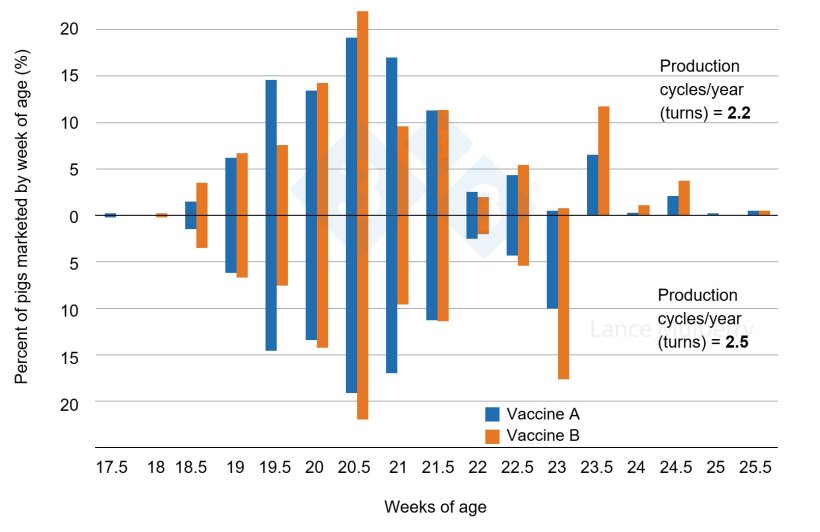
2. Risk reduction: Predictable and consistent outputs allow for more accurate long-term planning, which results in more confident contracting and hedging.
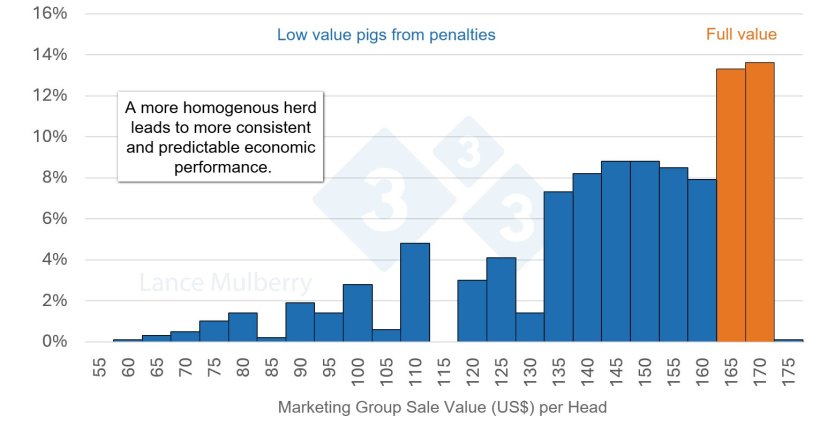
When modeled across multiple production cycles, even modest improvements in uniformity can yield double-digit percentage gains in profitability. These are the kinds of returns that traditional cost-cutting simply cannot match.
Measuring return on precision
The return on investment in precision production depends on both scale and data maturity. In early stages, the value often comes from identifying “hidden” inefficiencies, variation that was previously invisible. As information systems mature, returns shift toward more towards profit optimization, prediction, and... assisted decision making.
Economic modeling can help quantify these gains. One useful approach is to divide returns into:
- Direct returns, such as reduced feed cost per kilogram of gain, improved survivability, facility utilization, and marketing penalties.
- Indirect returns, like proactive decision making, employee feedback and training, and reduced disease risk.
- Strategic returns, including greater adaptability to market or regulatory changes.
Producers who integrate precision data into long-term planning gain not just higher average profits but also narrower swings between good and bad years, a key marker of resilience. In other words, the payoff from precision is not only higher profitability, but more reliable profitability.
Investing for resilience
In volatile markets, resilience has its own economic value. The ability to maintain output and quality despite shocks, whether from feed costs, disease, or market disruptions, translates into risk-adjusted profitability. Investors and lenders increasingly recognize this stability as a form of capital efficiency.
Precision production builds resilience through feedback. By continuously measuring performance and adjusting decisions, it creates a self-correcting system. Problems are caught early, and variability is managed before it turns into loss. In this way, precision is not only about efficiency, but also about control. The producer gains the power to steer outcomes rather than merely respond to them.
The next step
The magnitude of investment in precision production is not just a matter of money spent; it’s a matter of strategic intent. The goal is to transform information into value, and variability into predictability. By investing in measurement, data integration, and analysis, producers are building a new kind of piggybank, one that doesn’t just hold value but multiplies it.
In future discussions, we’ll explore how these investments reshape decision-making at the herd, enterprise, and supply chain levels. For now, the lesson is clear: profitability in modern swine production is not found in cutting costs, but in creating systems that pay dividends every day through precision, consistency, and resilience.
Watch the free webinar “Precision Production of Pigs – Unlocking Profitability Through Managing Variation” to learn more about actionable strategies to reduce variation, improve carcass value, and enhance overall farm profitability.