

























 2
2
You can access the survey HERE (although you can no longer participate).
Question: How clinically significant do you think influenza is in pigs?
(353 responses)

More than half of survey participants rated the clinical importance of this disease as high (and over 80% ratied it as moderate or high) (Figure 1).
We know that the influenza virus damages the respiratory system both structurally and functionally and causes macrophages—the primary line of defense—to reduce their phagocytic activity, thereby diminishing the animal's ability to eliminate pathogens. This situation favors the onset or exacerbation of secondary bacterial complications.
It is estimated that the clinical presentation associated with the influenza virus causes losses of $3 per pig sold and up to $10 in cases of co-infection with PRRSV or M. hyopneumoniae.
Even so, we likely underestimate its impact, as there is a very high prevalence in most countries—where it is difficult to find negative farms—and the circulation of two or more subtypes on the same farm is also common. We lack conclusive studies that assess the true impact of this phenomenon.
Question: Do you vaccinate against the influenza virus on your farm?
(390 responses)
Despite the above remarks and the respondents' perception of clinical importance, nearly one-third of participants report never vaccinating against influenza. There are marked geographical differences: while Germany has the highest rate of routine use (72%), in Asian countries, between 92% and 100% of respondents admit to never having used the vaccine (Figure 1).
What does the literature tell us about influenza vaccination in pigs?
Studies suggest that in contexts of high infection pressure, the return on investment is significant, driven mainly by improvements in average daily gain and reductions in antibiotic treatments. Some authors condition this profitability on vaccine efficacy being equal to or greater than 80%; in such scenarios, vaccination would yield net gains of $0.9 to $3.4 per pig.
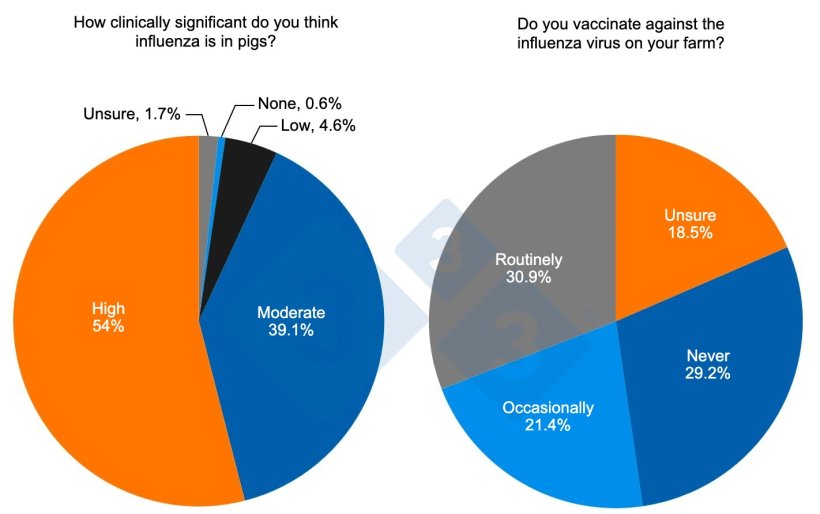
Figure 1. Most significant results of the survey. Perception of the impact of influenza and use of vaccination in pigs.
Beyond the clinical or subclinical impact on farms, it is essential not to underestimate the role of pigs in the ecology of the influenza virus, where they act as much more than just a host.
Question: Which of the following statements is true?
- Humans can be a source of influenza virus infection for pigs (true)
- Pigs can be a source of influenza virus infection for humans (true)
- Both are correct (correct)
- Neither is correct
- I don't know
(353 responses)
Influenza can be transmitted from humans to pigs and from pigs to humans.
To initiate infection, the influenza virus binds to sialic acid receptors in the respiratory epithelium. There are two main configurations of these receptors, and the difference between them is the main barrier to the influenza virus jumping from one species to another. The virus must also overcome other factors, such as the difference in body temperature between birds and mammals. Interestingly, pigs have both types of receptors, making them a “mixing vessel” (Figure 2). This allows them to be infected by both avian and human viruses, facilitating genetic reassortment and the emergence of new strains with pandemic potential, which is what happened in 2009. It should be noted that immediately after making the journey from pigs to humans, the 2009 pandemic virus made its way back.
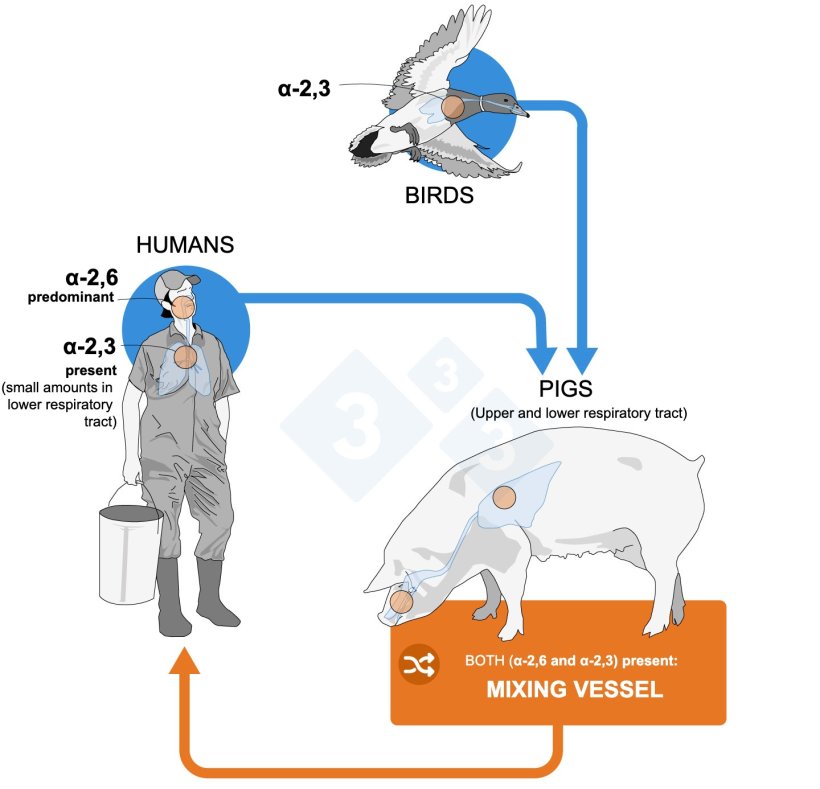
Figure 2. Distribution of influenza virus receptors in humans, birds, and pigs. There are two main configurations of these receptors: α-2,3, which is exclusive to birds, and α-2,6, which is predominant in humans. Pigs have both configurations throughout their respiratory tract and are therefore more easily infected by both avian and human viruses.
If we look closely at this point, we can conclude that transmission from humans to pigs (reverse zoonosis) appears to be much more frequent than from pigs to humans, as demonstrated by phylogenetic analysis of the lineages currently circulating in pig herds: most originate in humans (4 out of 5 in America and 3 out of 4 in Europe; the remainder on each continent originate in birds).
Despite this evidence, the survey reveals that more than 25% of participants are unaware that transmission is bidirectional, and 14% believe that the only possible route of transmission is from humans to pigs.
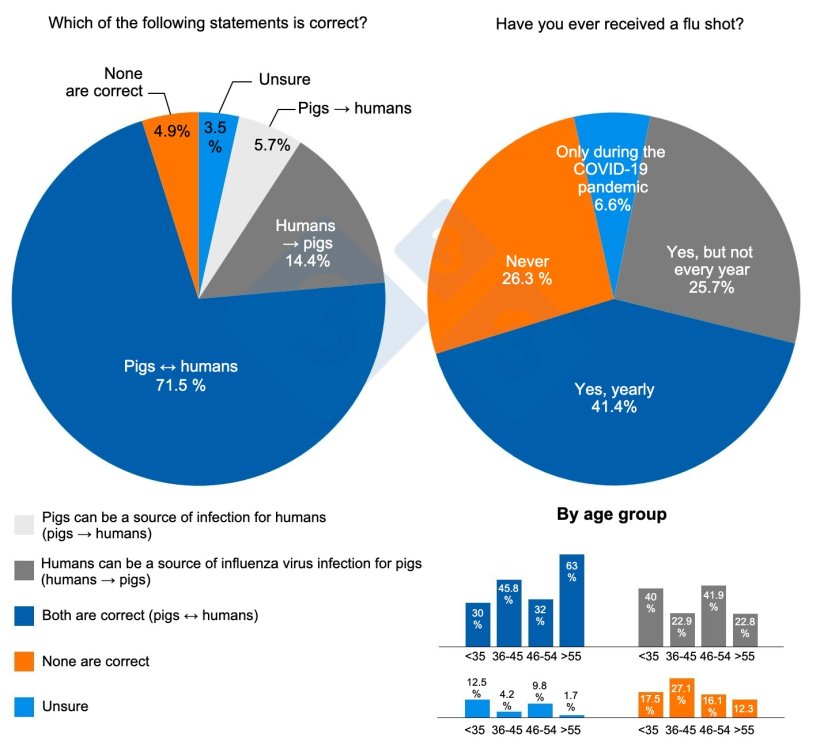
Figure 3. Most significant results of the survey. Perception of the transmission of the influenza virus between humans and pigs and vaccination in humans. Why do people who have ongoing contact with pigs (farmers, veterinarians, etc.) or with potentially infected samples (laboratory staff, slaughterhouse workers, etc.) need to be vaccinated against seasonal influenza?
This information leads us to the analysis of the last question:
Question: Have you ever received the flu shot?
(366 responses)
Although over 85% recognize that humans are a source of infection for pigs, only 41.4% of professionals are vaccinated annually against seasonal flu, and more than a quarter admit to never having been vaccinated (Figure 3). Clearly, vaccinating professionals who work with pigs is one of the simplest tools we can use to minimize the chance of pigs becoming infected from humans.
Demographic and geographic analysis reveals notable differences:
- Brazilian professionals have the highest annual vaccination rates (almost two-thirds).
- In Italy, around 50% have never been vaccinated.
- Germany stands out, with more than a third of respondents admitting that they have never been vaccinated, despite reporting the highest vaccination rates in animals.
Regarding age, there is a direct correlation between age and vaccination. The over-55 age group is the most aware (63% annual vaccination), compared to 30% in the under-35 age group. In the latter group, 12.5% were only vaccinated during the COVID-19 pandemic, suggesting a lack of adherence to seasonal prophylaxis outside of health crisis contexts.
Given that seasonal vaccination of personnel in contact with pigs plays a role that goes beyond the individual protection of people, this data should be of concern to us.
There does not seem to be any real reluctance to vaccinate, but some age groups have not adopted the habit of getting vaccinated every year, probably because they do not take into account the role they play as a source of infection for pigs, among other factors.
Vaccinating farm staff and veterinarians is not only an act of individual health, but is also an essential biosecurity measure to protect animal production and human health (Figure 4). Apart from vaccination, another simple measure we could apply is to limit access to animals by staff who show symptoms compatible with influenza.
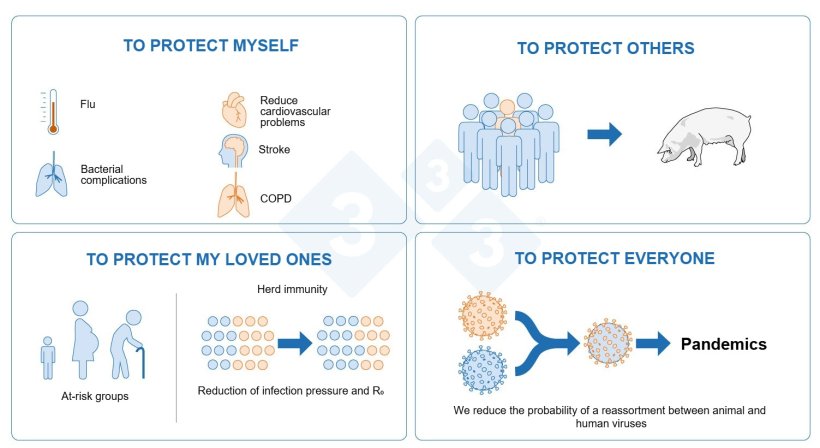
Figure 4. Why should we get the influenza vaccine?
Table 1. Conclusions.
| High awareness, but low correlation with our actions. |
|---|
| Animal health: |
|
Strong perception of the impact of influenza in pigs: >80% consider the impact to be moderate or high. Vaccination implementation: Despite this perception, vaccination implementation still has a long way to go.
|
| Transmission between species and human health: |
|
High awareness of the risk of bidirectional infection: 71.5% of respondents know that humans can infect pigs and vice versa. However: Vaccination in humans:
|