
























 0
0
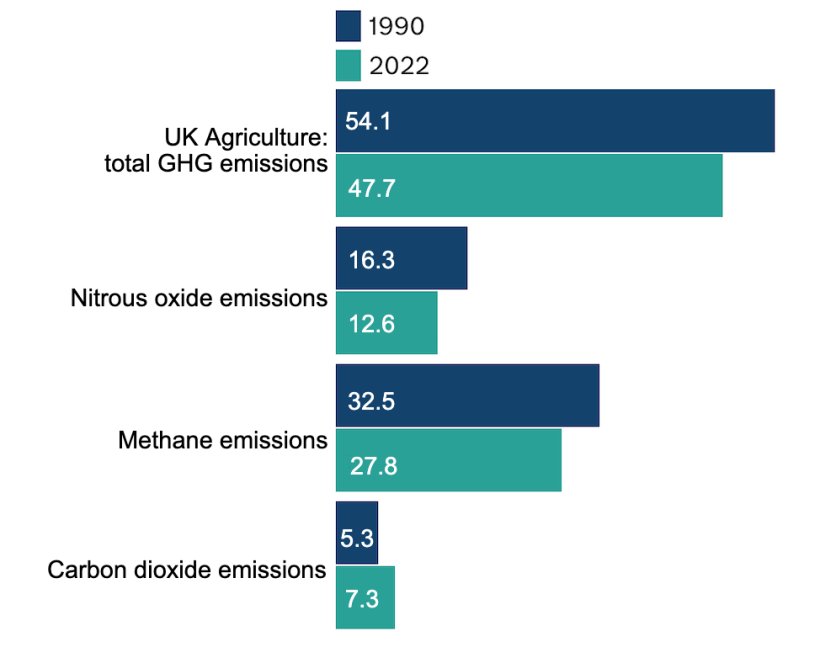
In 2022, agriculture contributed an estimated 12% of total UK greenhouse gas (GHG) emissions (in million tonnes carbon dioxide equivalent, MtCO2e), a similar proportion to 2021. It is a major source of both nitrous oxide and methane emissions in the UK, accounting for 70% of total nitrous oxide emissions and 49% of all methane emissions in 2022. In contrast, agriculture only accounted for 2.3% of total carbon dioxide emissions. Agricultural emissions come from livestock, agricultural soils, stationary combustion sources and off-road machinery. It is important to note that there are relatively large uncertainties in estimating agricultural emissions, and the entire time series is revised each year to take account of methodological improvements in the UK emissions inventory.
Between 1990 and 2022, total UK agricultural GHG emissions have decreased by 12%, driven by reductions in livestock numbers and use of manufactured fertilisers.

From 1990 to 2022, UK emissions intensities from cattle, dairy and pigs all showed declining trends, decreasing by 4%, 22% and 46% respectively. Sheep emissions intensity has fluctuated over this period, and in 2022 was 5% higher than in 1990.
Pig emissions intensity
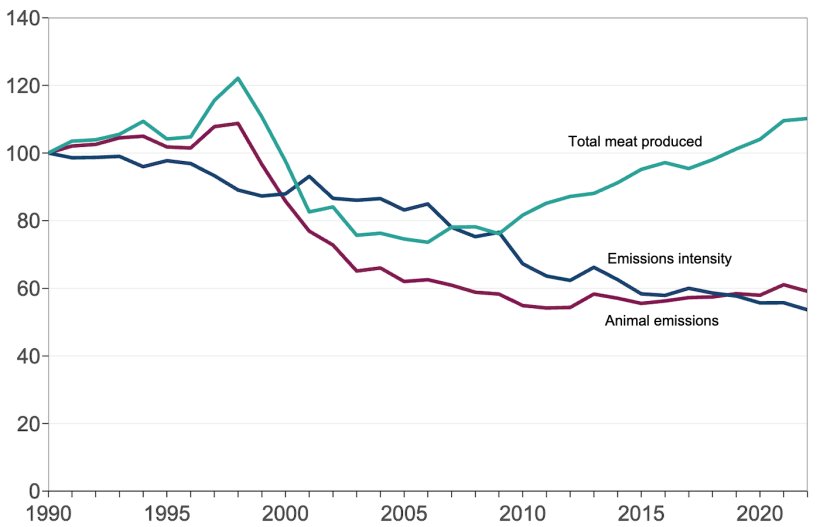
For pigs, the emissions intensity (GHG emissions from producing a kg of pork) has steadily declined over time, with a 46% reduction between 1990 and 2022. This was driven by an overall reduction in animal emissions (-41%) and an increase in meat production (10%). Pig emissions intensity has seen the largest proportional decline since 1990 when compared to emissions intensities for cattle, dairy and sheep.
November 28, 2025/ UK Government/ United Kingdom.
https://www.gov.uk