























 Company
Tonisity
Ireland
3
products
101
Publications
511
Followers
Company
Tonisity
Ireland
3
products
101
Publications
511
Followers
Weaning Pathophysiology in Piglets: Impacts on the Gut, Early Feed Intake and Performance Across the Production Cycle


Weaning is one of the most disruptive transitions in modern pig production. The abrupt separation from the sow, environmental change, social reorganization and, above all, the immediate shift from a highly digestible liquid diet to a more complex solid feed generate multifactorial stress that destabilizes gastrointestinal homeostasis and compromises future performance (Tang et al., 2022; Zheng et al., 2021).
Within the first 24–48 hours after weaning, piglets typically show reduced villus height, crypt hyperplasia and a lower villus:crypt ratio, especially in the jejunum and ileum (Pluske et al., 1996; Van Beers-Schreurs et al., 1998). These lesions coincide with reduced disaccharidase activity and increased intestinal permeability driven by downregulation of tight-junction proteins, which raises the risk of bacterial translocation and inflammation (Kelly et al., 1991; Wijtten et al., 2011; Tang et al., 2022).
The intestinal microbiota also undergoes abrupt restructuring. Beneficial genera such as Lactobacillus and Bifidobacterium decline rapidly, while Enterobacteriaceae expand, increasing susceptibility to post-weaning diarrhea particularly in systems without medicinal zinc (Eriksen et al., 2021; Han et al., 2024).
Although post-weaning performance is influenced by genetics, health, housing and management, early feed intake during the first 24–72 hours is consistently identified as a major determinant of physiological adaptation. Early eaters maintain greater villus height, shallower crypts, stronger epithelial integrity and more stable microbiota. Piglets with low intake tend to experience continued intestinal disruption that compromises nursery performance and may affect finishing weights (Vente-Spreeuwenberg et al., 2003; Fabà et al., 2024).
Early growth after weaning is one of the best predictors of outcomes later in the production cycle. Small initial deficits tend to amplify, increasing batch variability, the proportion of fall-behinds, housing costs and total time to reach market weight (Kwon et al., 2025; Kim, 2021).
Mitigation Strategies: What the Science Shows
Four pillars consistently emerge from the literature:
- Stimulate early intake through highly digestible diets, enhanced palatability, higher moisture content and well-structured creep feeding (Dong & Pluske, 2007; Fabà et al., 2024).
- Support the mucosa using highly digestible proteins, simple carbohydrates, fermentable fibers, glutamine and nucleotides (Kim, 2021; Zheng et al., 2021).
- Modulate the microbiota with probiotics, prebiotics, organic acids and fermentable substrates that promote SCFA production and reduce Enterobacteriaceae (Han et al., 2024).
- Control inflammation and permeability by preserving tight-junction proteins and preventing excessive immune activation (Tang et al., 2022; Wijtten et al., 2011).
A practical example widely adopted on commercial farms is the use of high-moisture gruels during the first 2–3 days post-weaning, which improves feed acceptance and reduces the length of the fasting period one of the main triggers of intestinal disruption.
Emerging Evidence: Isotonic Protein Solutions
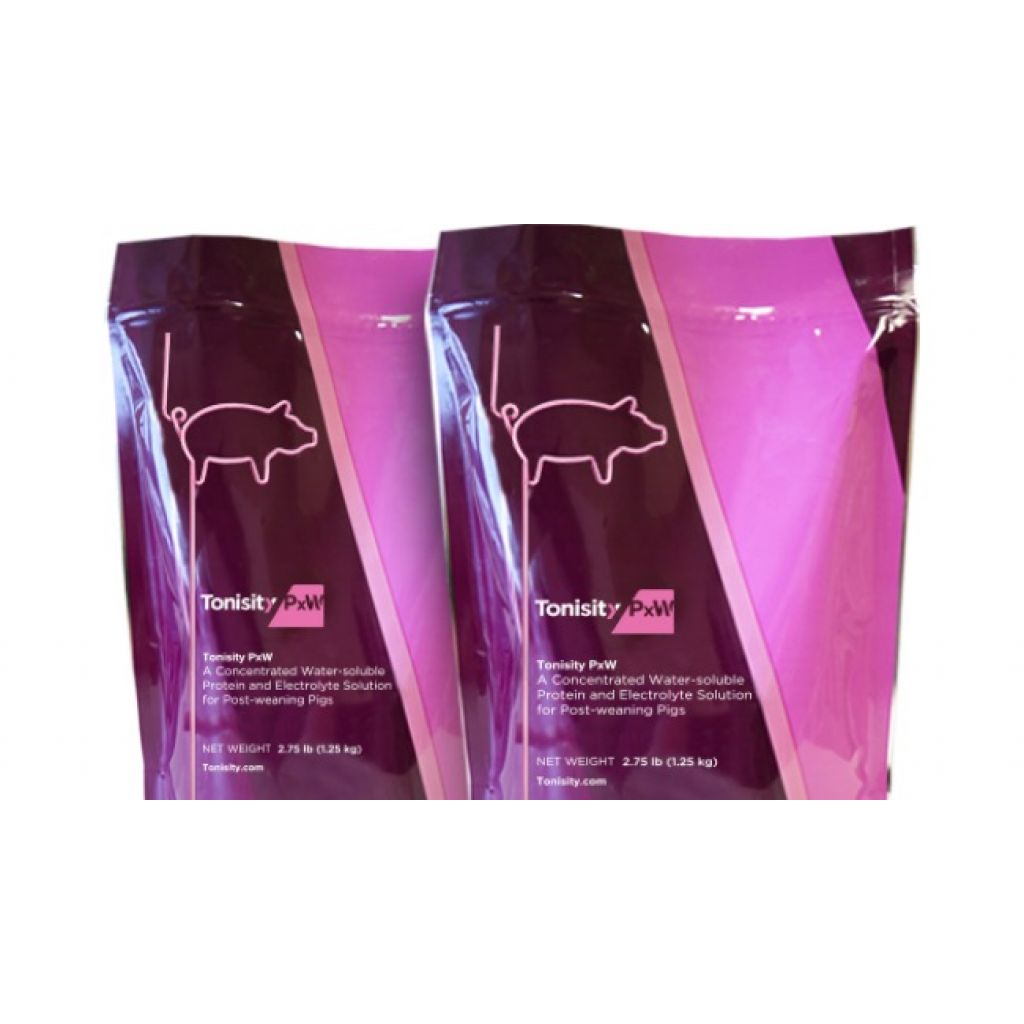
Here are the explanations about the isotonic protein solution called Tonisity Px:
At weaning, Tonisity Px acts by:
- Protecting Gut Integrity: Feeding the enterocytes directly to prevent the villus shortening and "leaky gut" associated with undernutrition.
- Stimulating Feed Intake: Bridging the "hunger gap" to ensure piglets approach and consume solid feed sooner post-weaning.
- Sustaining Growth: Reducing the severity of the post-weaning growth check to ensure more piglets meet their performance targets.
Key Results using Tonisity Px
All studies and data referenced in this article are presented in greater technical detail in the full paper. More information is available here: Tonisity Px at Weaning: A Proven Strategy to Boost Intake, Gut Health and Piglet Performance. For further information, please contact us at info@tonisity.com.
Improved Feed Intake and Weight
Study 16-003-P-R (Spain – 608 pigs)
- Feed intake 30–40% higher in the three days pre-weaning
- 86% vs 77% of piglets achieved positive ADG in the first week post-weaning
Study 24-010-P-P (Spain – 200 pigs)
- 4.2× higher feed intake in the first two hours post-weaning
Study 16-002-P-R (Spain – 150 pigs)
- Feed intake 2.1× higher (+192 g/pig) in the first five days post-weaning
- 2.6× more piglets achieved positive ADG in the first week
Study 25-064-P-P
- 89% of Tonisity Px piglets achieved positive ADG in week one vs 75% in controls
Study 18-126-P-P
- +200 g extra weaning weight and +300 g extra nursery weight (2 weeks post-weaning)
- 65% less E. coli after 1 week in nursery
- +34% taller villi after 1 week in nursery
Long-Term Performance and Nursery Mortality
Study 23-031-P-P (Belgium – 481 pigs)
- +1.92 kg (+8%) higher weight at the end of nursery (p < 0.001)
- 35% reduction in nursery mortality
Protocols for “Fall-Behind” Piglets
Field observations
Study 23-001-P-P (Vietnam - 20 pigs)
- Mortality reduced in the first week post-weaning
- +17% increase in average weight (+1,070 g)
- Visible health improvements reported within three days (shinier hair, less diarrhoea)
Study 22-069-P-P (Vietnam - 200 pigs)
- +3.8% improvement in weight at 3 weeks in nursery
- 15.7% better FCR for the first 3 weeks in nursery (1.44 vs 1.71 control)
- Visual improvements: brighter eyes, shinier skin, increased agility
Conclusion
Weaning is not just a dietary shift; it is a systemic physiological event that shapes the piglet’s productive potential. Protecting gut integrity and ensuring early feed intake are key determinants of performance in the nursery and subsequent phases. Science-based strategies precise nutrition, microbiota modulation, mucosal support and inflammation control are essential to minimize losses. Evidence indicates that isotonic protein solutions offer an important complementary tool, acting on the key mechanisms underlying post-weaning intestinal disruption.
References
Dong & Pluske (2007)
Eriksen et al. (2021)
Fabà et al. (2024)
Gong et al. (2025)
Han et al. (2024)
Kelly et al. (1991)
Kim (2021)
Kwon et al. (2025)
Pluske et al. (1996)
Tang et al. (2022)
Van Beers-Schreurs et al. (1998)
Vente-Spreeuwenberg et al. (2003)
Wijtten et al. (2011)
Zheng et al. (2021)


Contact:
Contact us using the following form.