























 Company
Kemin
Belgium
6
products
36
Publications
371
Followers
Company
Kemin
Belgium
6
products
36
Publications
371
Followers
A Synergistic Enzyme Strategy: Protease and Amylase to Improve Digestibility and Reduce Post-Weaning Diarrhea



The Postweaning Challenge
The postweaning period is a critical phase in piglet production, marked by abrupt dietary changes and physiological stress. Transitioning from sow’s milk to solid feed introduces complex plant proteins and starches that the immature digestive system of piglets struggles to process efficiently. This incomplete digestion can result in undigested protein and complex carbohydrates reaching the hindgut, where they fuel pathogenic bacteria and increase the risk of postweaning diarrhea (PWD).
Digestive Enzyme Deficiencies After Weaning
Research has shown that the secretion of endogenous digestive enzymes, including proteases and amylases, decreases significantly after weaning. This reduction impairs the piglet’s ability to digest protein and starch, shifting the site of digestion from the small intestine to the large intestine. Here, undigested nutrients are fermented, producing toxic metabolites such as ammonia and biogenic amines, which predispose piglets to intestinal dysbiosis and diarrhea.
Traditionally, strategies to reduce PWD have focused on lowering crude protein and balancing amino acids. While effective, this can compromise growth if digestibility isn’t optimized. Enzyme supplementation, particularly proteases and amylases, offers a synergistic solution.
Amylase Activity and Weaning: Insights from Classic Studies
A key finding from the foundational work of Lindemann et al. (1986, J. Anim. Sci. 62:1298–1307) is that pancreatic amylase activity undergoes a marked decrease immediately after weaning. Their data show that while amylase activity increases with age under normal conditions, the stress and dietary shift of weaning cause a transient but significant depression in enzyme output. This is echoed by Jensen et al. (1997, J. Anim. Sci. 75:437–445), who documented a significant drop in amylase activity at weaning, followed by a gradual recovery as the pancreas adapts to the new diet. This temporary gap in amylase production means that piglets are less able to digest dietary starch at the very moment their diet becomes more starch-rich, increasing the risk of undigested carbohydrates reaching the hindgut and contributing to digestive disturbances.
Protease: Enhancing Protein Utilization
Proteases hydrolyze complex proteins into peptides and amino acids, improving
absorption and reducing undigested substrates that feed harmful microbes. Benefits include:
- Improved Protein Digestibility: Protease increases amino acid availability, even in diets with reduced crude protein, supporting growth without excess nitrogen excretion.
- Reduced Diarrhea Incidence: By minimizing undigested protein in the hindgut, protease supplementation lowers the substrate available for pathogenic bacteria, reducing the risk of PWD.
- Gut Health Support: Proteases can deactivate anti-nutritional factors in soybean meal (e.g., glycinin, β-conglycinin), reducing gut inflammation and supporting mucosal integrity.
Amylase: Addressing Starch Digestibility
Starch is a primary energy source in piglet diets, but its digestion depends on pancreatic α-amylase, which, as shown above, drops sharply after weaning. Supplementing with exogenous amylase:
- Bridges the Amylase Gap: By providing additional amylase during the period of endogenous enzyme depression, exogenous supplementation helps maintain efficient starch digestion in the small intestine.
- Reduces Fermentation Risk: Improved starch digestibility reduces the flow of undigested carbohydrates to the colon, lowering the risk of pathogenic fermentation and diarrhea.
- Supports Gut Integrity: Studies indicate that amylase supplementation, especially when combined with other enzymes, improves villus height and nutrient absorption.
Synergistic Effects: Protease and Amylase Together
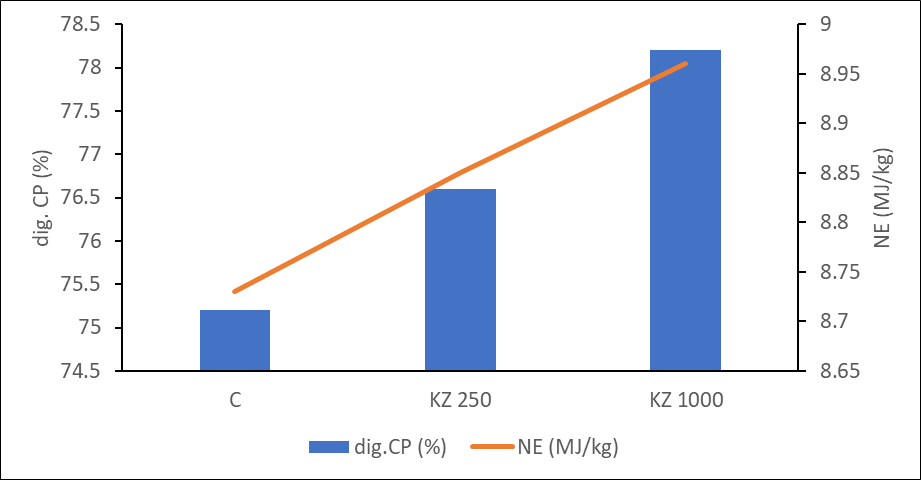
Combining protease and amylase addresses two major digestibility gaps: protein and starch. Controlled studies in weaned piglets have shown that supplementing diets with protease and amylase significantly increases the digestibility of organic matter, dry matter, crude protein, non-starch polysaccharides, crude fiber, and gross energy. For example, increasing enzyme inclusion (KZ) from 250 to 1000 g/ton resulted in a 3% increase in crude protein digestibility and a corresponding rise in dietary net energy (Fig. 1). Moreover, the average of multiple trials demonstrated a reduction in feed conversion ratio (FCR) and a positive return on investment when enzyme supplementation was applied.
Fig. 1. Effect of protease-amylase complex (KZ) dietary supplementation in crude protein (CP) digestibility and net energy (NE) of weaned piglets.
Practical Recommendations
- Early Inclusion: Add protease and amylase to nursery diets immediately postweaning to bridge the amylase and protease gaps.
- Pair with Moderate Protein Reduction: Slightly reduce crude protein and balance with synthetic amino acids.
- Monitor Outcomes: Track fecal scores, growth rates, and feed conversion to assess efficacy.
Conclusion
Postweaning diarrhea is a multifactorial challenge, but poor digestibility of protein and starch is a major driver. A synergistic enzyme approach, combining protease and amylase, optimizes nutrient utilization, reduces diarrhea risk, and supports sustainable pig production. With the only registered protease on the market and proven benefits of amylase, producers have a powerful tool to improve piglet health and performance.
References
-
Lindemann, M. D., Cornelius, S. G., El Kandelgy, S. M., Moser, R. L., & Pettigrew, J. E. (1986). Effect of Age, Weaning and Diet on Digestive Enzyme Levels in the Piglet. J. Anim. Sci. 62:1298–1307. https://doi.org/10.2527/jas1986.6251298x
- Jensen, M. S., Jensen, S. K., & Jakobsen, K. (1997). Development of Digestive Enzymes in Pigs with Emphasis on Lipolytic Activity in the Stomach and Pancreas. J. Anim. Sci. 75:437–445. https://doi.org/10.2527/1997.752437x
- Furlani, N. R., Da Motta, S. A. B., Ramos, B. T., Fernandes, W. V., de Farias, M. R. S., Riveros, R., Tizziani, T., & Hannas, M. I. (2025). Protease Enzyme Supplementation in Weaning Piglets Fed Reduced Crude Protein Diets: Effects on Gut Health Integrity and Performance Response. Animals, 15(14), 2109. https://doi.org/10.3390/ani15142109
- Cho, S., Cai, L., Kiarie, E. & Kim, I. H. (2024). Effect of multi-enzyme supplementation on growth performance, digestibility, blood profile, intestinal villus height, and faecal gas emission in weaning pigs. Journal of Animal and Feed Sciences, 33(2), 211–216. https://doi.org/10.22358/jafs/172277/2023 Velayudhan, D., Li, W., Dusel, G., Gracia, M. I., Kumar, A., Shoesmith, E., Vinyeta, E., Adeola, O., & Marchal, L. (2022). 91 Meta-Analysis of 4 Trials: The Effect of Multi-Enzyme Containing Xylanase, β-glucanase, Amylase and Protease on Growth Performance in Weaned Pigs. Journal of Animal Science, 100(Suppl 2), 37–38. https://doi.org/10.1093/jas/skac064.060
- Li Z. et al. Compound Enzyme vs Antibiotics in Weaned Pigs. Front. Microbiol.,Li ZQ, Tang LZ, Liu N, Zhang F, Liu X, Jiang Q, Chen JS and Ma XK (2021) Comparative Effects of Compound Enzyme and Antibiotics on Growth Performance, Nutrient Digestibility, Blood Biochemical Index, and Intestinal Health in Weaned Pigs. Front. Microbiol. 12:768767. https://doi.org/10.3389/fmicb.2021.768767 Zaworski, K., Wychowański, P., Szkopek, D., Woliński, J., Donaldson, J., Pierzynowski, S., & Pierzynowska, K. (2024). The Regulatory Role of Pancreatic Enzymes in the Maintenance of Small Intestinal Structure and Enterocyte Turnover with Special Reference to Alpha Amylase. International journal of molecular sciences, 26(1), 249. https://doi.org/10.3390/ijms26010249
- 2021. [frontiersin.org]
Contact:
Contact us using the following form.