























 Company
Cargill Animal Nutrition and Health
United States
3
products
4
Publications
143
Followers
Company
Cargill Animal Nutrition and Health
United States
3
products
4
Publications
143
Followers
From Foraging to Gut Maturation: Rethinking Pre‑Starter Nutrition for Modern Pig Production


Trials with a novel diversified feed confirmed this and showed increased feed intake and a higher proportion of piglets consuming feed per litter.
Cargill Animal Nutrition & Health
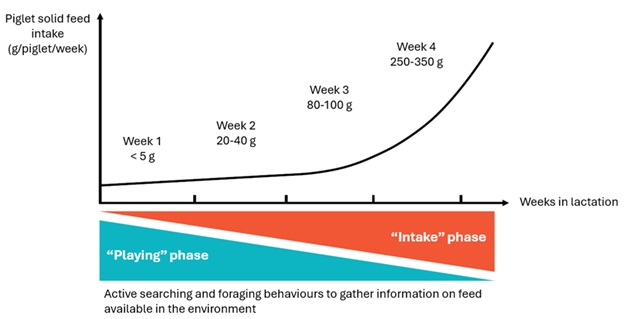
The natural feeding behaviour of newborn piglets is characterised by play, foraging, and eventual feed intake. Shortly after birth, piglets enter a pronounced “playing” phase while still being nourished by the sow. This stage is crucial for their development. During this phase, piglets actively explore their environment through searching and rooting behaviours. Much of this activity involves manipulating and playing with feed rather than consuming it. The primary function of this phase is learning, allowing piglets to become familiar with the physical characteristics and availability of feed in their environment.
As piglets mature, their feeding behaviour gradually transitions into an “intake” phase. At this stage, the emphasis shifts from exploration to actual consumption, as piglets increasingly rely on solid feed to meet their nutritional requirements in addition to sow milk. This progression has been demonstrated in several studies (Figure 1), which show that solid feed intake increases as sow milk production declines (more weeks into lactation).
Figure 1 - The two phases of natural feeding behaviour of suckling piglets.
Adapted from Pluske et al., 2007, Sulabo et al., 2010, Middelkoop et al., 2019, Hoojgaard et al., 2020.
Diversified feed stimulates natural feeding behaviour
However, in commercial pig production systems, opportunities for natural foraging are limited, as suitable rooting materials are rarely available. At the same time, research has shown that stimulating natural foraging behaviour provides substantial benefits, including improved piglet growth, increased feed intake, and enhanced adaptation to weaning. In commercial settings, this behaviour can be encouraged by offering piglets a so-called ‘diversified feed’.
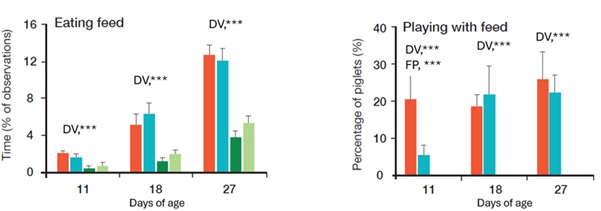
Such a pre-starter feed, provided during the first days of life, should incorporate at least one distinct physical characteristic, such as sound, colour, shape, size, aroma, texture, or flavour, or a combination of these elements. Studies have demonstrated that piglets offered a diversified feed spent approximately four times more time eating from the beginning of the experiment compared with piglets fed a standard pellet. More importantly, piglets receiving a diversified feed spent about 20% of their time interacting and playing with the feed, whereas piglets fed pellets alone showed virtually no feed-related play behaviour (Figure 2).
Figure 2 - Effect on eating and playing time with enriched feed and single pellets.
Adapted from Middelkoop et al., 2019
Adjusting conventional pre-starter formulations
The research done on natural feeding behaviour in young piglets has significantly reshaped our understanding of pre-starter diet composition and formulation. Conventional pre-starter pellets are typically high in lactose and low in (inert) fibre, reflecting the long-held assumption that piglets prefer sweet flavours and have limited tolerance for fibre. However, growing evidence indicates that a pre-starter diet does not need to mimic sow milk. Instead, it should complement it by providing nutrients that are insufficiently supplied by milk, particularly specific amino acids in appropriate ratios that are essential for supporting gut development and immune function. It should also include functional fibre sources that support early digestive tract maturation and microbiome development. In nature, suckling piglets can ingest a diversity of roughages they find in their environment. These roughages bring a diversity of fibre fractions that are essential to piglet’s gut maturation. This is lacking on a commercial pig unit and must be corrected with pre-weaning feed.
Similarly, a pre-starter diet does not need to be inherently sweet to stimulate feed intake. In natural environments, young piglets are exposed to and actively seek savoury flavours, such as those found in insects. These flavours may exert beneficial physiological effects, including increased salivation.
Collectively, these new insights show that an effective pre-starter diet that complements sow milk should be more nutritionally targeted, more diverse in composition, and more aligned with the piglet’s natural feeding behaviour than is common in current formulations.
Introducing a new diversified feed for young piglets
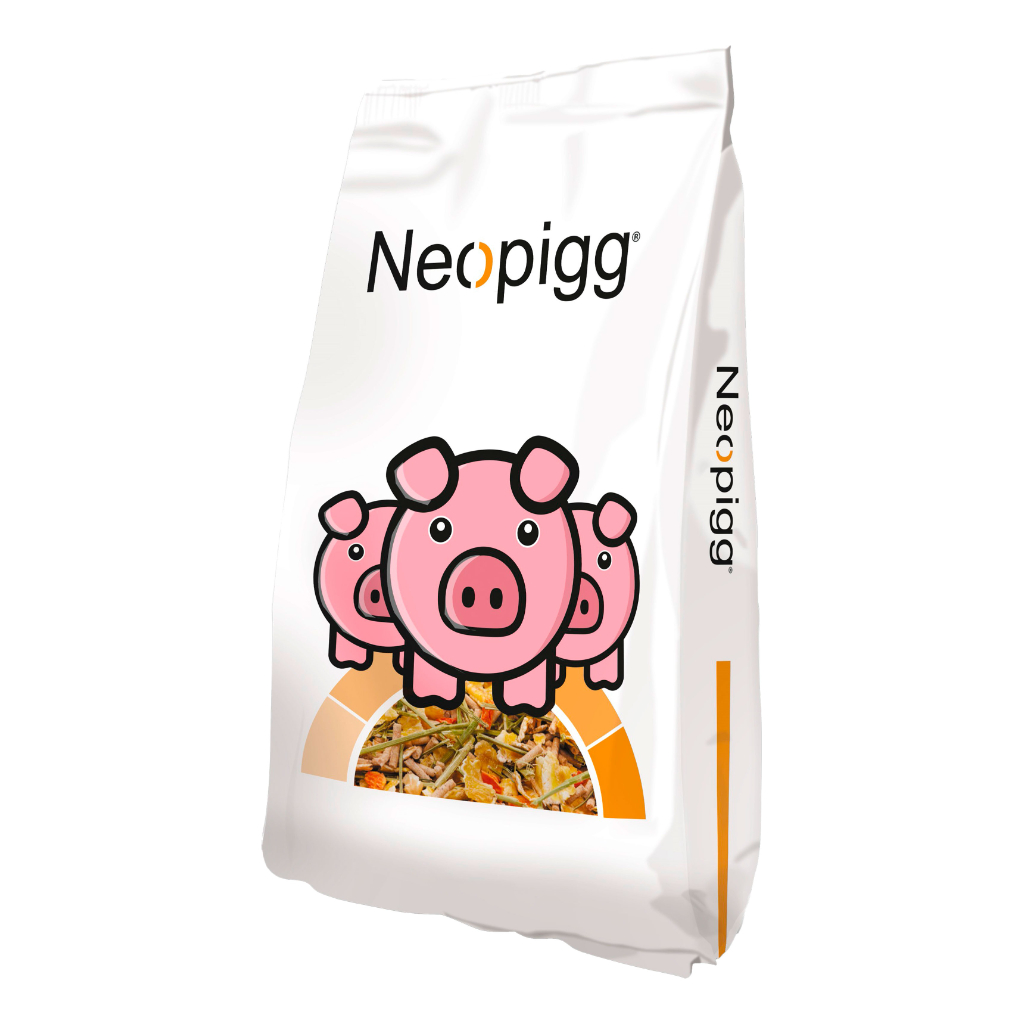
Drawing on recent scientific findings and validated through field trials, Cargill Animal Nutrition & Health (Cargill ANH) developed Neopigg Nutriplay®. This formulation combines pellets with multiple complementary textures and savoury flavour profiles to stimulate feed exploration and intake. It delivers an optimised balance between small, energy-dense pellets and fibrous components, with particle size specifically engineered to support appropriate pre-weaning feeding behaviour (Figure 3).
Figure 3 - Diversified feed for suckling piglets includes roughages, energy rich pellets and the right flavours.
 Trials with the enriched feed showed a doubling in the number of eaters at 11 and 19 days of age, and an increased feed intake from 10 days of age by 46% (Figure 4). Pig farmers who use the new enriched feed confirm this, reporting better pre-starter and post-weaning feed intake levels, more eaters (even the small piglets eat more) and less disease pressure and diarrhoea after weaning.
Figure 4 - Difference between feed intake and percentage of eaters / litter with enriched feed and control feed.
 Conclusion
Pig genetic enhancement has led to increased litter sizes and high lean growth potential. This comes with challenges: piglets with lower birth weights, less mature at weaning, and sow milk supply unable to meet their nutritional demands. Designing the right feeding program for young piglets is crucial, as it needs to support gut health and higher feed intake, the key foundations to growth and development and better adaptation to weaning. However, in commercial pig production, opportunities for foraging are restricted, as appropriate rooting materials are seldom available. Therefore, a pre-starter that is offered alongside sow’s milk should be designed to replicate the natural feeding behaviour of piglets, incorporating both the exploratory playing phase and the actual feed intake phase, as closely as possible.
The importance of feed diversification has been researched in recent years, leading to new insights and opportunities for commercial settings. Neopigg Nutriplay® is a great example of this. It represents a next-generation, diversified feed developed using latest research in early-life pig nutrition and validated in collaboration with pig farmers. Its unique form and composition stimulate natural feeding behaviour, are practical to use on farm (no mixing with other feed is needed), and help piglets transition more smoothly through weaning while supporting optimal growth.


Contact:
Contact us using the following form.