


























 0
0
Throughout history, producers and marketers of goods and services have undergone various transformations in the ways they interact with the market. Analyzing this evolution is an essential part of understanding the challenges that pig farming faces today operating within its different contexts, as well as for establishing strategies that make it possible to respond effectively to an environment characterized by increasing competitiveness.
From demand to supply: A paradigm shift
Demand phase: At this phase, customers went directly to producers in search of goods and services. Both end consumers and corporate buyers approached producers and merchants to request their products, creating a market dynamic focused primarily on producers' supply capacity and their ability to respond to existing demand in a timely manner.

However, over time, society, markets, and competition evolved rapidly. This gave way to the supply stage, where it was no longer enough to wait for customers to come to you. Producers and marketers were forced to actively go out and offer their products. In this new context, the likelihood of achieving valuable business opportunites depends on one fundamental principle: knowing your customers deeply.
In such a competitive world, sticking to demand-side logic is limiting. It is essential to act at the supply stage and turn customer knowledge into a strategic asset that boosts productivity and growth across the entire organization.
Beyond product quality
Pig farmers' success does not depend solely on the quality of the pork they produce on their farms. Safety, freshness, and sanitary standards are basic elements, but they are not enough. The real differentiating factor lies in the ability to know and understand customers in their different segments: B2B, B2C, and B2G (business to business, business to consumer, and business to government).
Each segment seeks different things and has different buying criteria and specific expectations. Understanding these needs, desires, and motivations not only allows you to design effective strategies but also opens the door to identifying new business opportunities.
Understanding what a restaurant chef values when choosing pork, what a large-scale retailer buyer expects, or what aspects a family prioritizes when shopping for groceries translates into key information for making strategic decisions.
Let's look at the main activities that pork producers should implement to gain a deep understanding of their customers: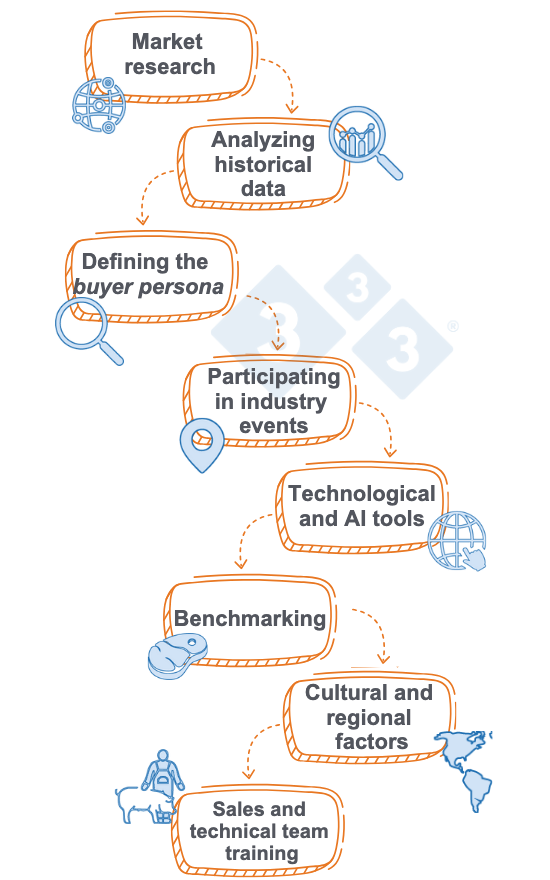
- Market research
Information is a critical asset. Implementing surveys, interviews, and focus groups tailored to each segment (B2B, B2C, and B2G) allows us to understand motivations, purchasing criteria, and consumption habits, and helps identify regional differences between and within countries, and understand the competitive landscape. Designing marketing, sales, and customer service strategies based on this type of information about customer behavior increases the likelihood of being highly effective.
- Analyzing historical data
Statistics from previous years provide valuable information. Reviewing purchasing trends, volumes, seasonality, and customer behavior allows you to anticipate demand and design more efficient supply strategies.
- Defining the buyer persona
Create detailed profiles of buyers, whether they are homemakers, chefs, supermarket purchasing managers, or public officials. Having a well-defined buyer persona—a fictional representation of your ideal customer—makes it easier to align the company's value proposition with the real needs of each customer.
- Participating in industry events
Attending food and agribusiness trade shows, symposiums, and forums, both private and governmental, opens up opportunities to learn about trends, identify new demands, and establish strategic business relationships.
- Using technological and artificial intelligence tools
The use of CRM to manage customer information, as well as monitoring technologies (cameras, accelerometers, thermography) and predictive demand models, strengthens productivity, animal welfare, sustainability, and strategy design throughout the value chain. By using AI tools, we will have better opportunities to make the pig farming industry more competitive.
- Benchmarking
Observing what direct competitors are doing and analyzing the practices of leading companies in other sectors provides valuable insights. With this information, we can adjust internal processes, innovate in our value proposition, and identify competitive advantages.
- Considering cultural and regional factors
Pork consumption varies depending on the country and region. Knowing and understanding local habits allows us to adapt our offerings and communication strategies.
- Training the commercial and technical teams
Knowing the customer is not the sole responsibility of the marketing department; the entire team must be prepared to identify needs, obtain valuable information, and transform it into strategic actions. Training in consultative sales and data analysis is essential for strengthening customer relationships.
In summary, a deep understanding of the customer is essential for pig farmers who want to be more competitive, moving from a tactical, production-focused approach to a strategic, customer-based approach. The pig farming industry can transform its processes, increase its productivity, and personalize its marketing, sales, and customer experience strategies, generating value-added business opportunities. But most importantly: Ensure that corporate clients or end consumers remain loyal and become embassadors for your brand or organization.