
























 0
0
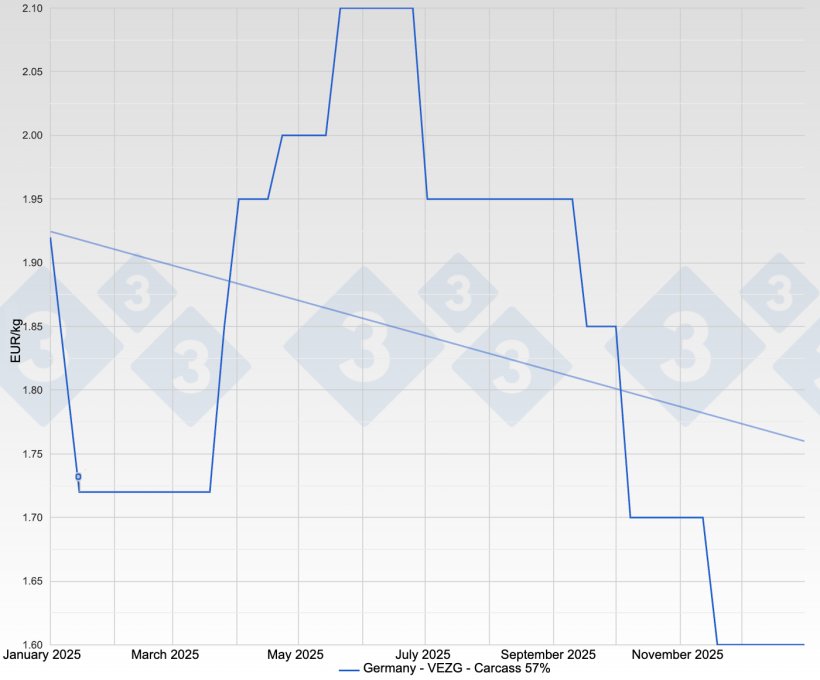
The German pig market ended December with a deceptive sense of calm. On the surface, much appeared stable, largely due to the Christmas business, yet beneath this veneer the situation remained tense. Prices for slaughter pigs held steady throughout the month at €1.60, which provided the market with some stability but brought no real relief. The supply of market-ready pigs remained high and slaughterhouses operated at near full capacity for much of the month. At the same time, the familiar pattern of regional differences once again became apparent. While marketing ran largely smoothly in some regions, volumes backed up noticeably in others. The Christmas business, now concluded, did provide a boost to meat demand, but overall it fell short of the expectations of many market participants. Demand impulses were sufficient to the market, but not strong enough to generate a sustained upswing.
The piglet market also remained subdued in December. After the price declines seen previously, supply and demand moved back into better balance. Piglet prices stayed stable at €40.00, which some viewed as a sign of tentative bottoming out. Nevertheless, trading conditions remained challenging. Free batches continued to require marketing and regional differences shaped this segment as well. Overall, however, there was more predictability than in the autumn, giving both producers and finishers some breathing space. The sow market was similarly balanced at year-end. Prices remained unchanged at €0.80 and available volumes could be marketed without difficulty. Processors had ramped up production ahead of the holidays, providing additional support to the market, before activity now seasonally eases.

Alongside day-to-day market developments, structural and political issues moved strongly into focus in December. The closure of the Perleberg slaughter site in particular stands as another clear signal of the ongoing structural change. Following Vion’s withdrawal from the German slaughter business and the sale to sow processor Uhlen, the site was taken permanently offline. Ongoing investigations by the Federal Cartel Office into suspected anti-competitive practices underline how sensitive the market has become to concentration processes. For many pig producers, especially in north-eastern Germany, the closure of Perleberg further tightens marketing conditions. Longer transport distances and fewer alternatives add to economic pressure. At the same time, the future of the Vion sites for sale in southern Germany remains unresolved. Westfleisch has once again signalled interest, while other market players are also being discussed as potential buyers. The sector is watching these developments closely, as they could permanently alter the balance of power within the slaughter industry.
Internationally, December was clearly shaped by events in Spain. The outbreak of African swine fever in wild boar in the Barcelona region unsettled the European market noticeably. Although key sales outlets could be kept open thanks to existing regionalisation agreements, limiting the damage, substantial volumes of Spanish pork were redirected within the EU. This additional supply intensified competitive pressure on the German market as well. Many market participants welcomed the fact that China recently reduced the punitive tariffs previously imposed on European pork. This step improves export opportunities and has a effect on the European market. Nonetheless, international trade remains fragile, as political decisions and animal disease events can trigger new uncertainties at any time.
As the year turns, attention shifts to a market that enters the new year on a stable footing, but with a very delicate balance. The Christmas business is complete and seasonally strong demand is now fading. At the same time, supply remains ample and significant price impulses are unlikely in the short term. Much will depend on how the situation in Spain develops and whether regionalisation agreements continue to have a stabilising effect. Structural changes in Germany will also only unfold their full impact over the coming months. Fewer slaughter capacities do not automatically bring relief and can instead create new regional bottlenecks. The German pig market therefore enters the new year with cautious realism. Prices have shown resilience in December, but the wide range of influencing factors highlights how quickly sentiment can shift.
What happens in 2026?
In the short term, conditions remain difficult. Currently high slaughter volumes in Germany and the EU are meeting persistently subdued demand. In addition, high pig inventories in China are weighing on the global market. Despite reduced tariffs, purchases remain limited, as the domestic market there is well supplied. This combination of oversupply and weak export demand could push the market further under pressure in the coming weeks. New lows cannot be ruled out in the short term, particularly if additional volumes from other EU countries flow into the internal market.
Relief is therefore less likely in the short term and more a prospect for 2026 in the long run. Structural change in pig production is continuing and is leading to a noticeable reduction in animal numbers. Herd reductions in sow production and farm exits take time to show an effect, but in the long run they have a market-cleansing impact. Although sow numbers have recently risen slightly in parts of Germany, the lack of farm succession and the EU-wide decline point clearly towards a long-term tightening of supply. At the same time, Germany is drawing lessons from recent years and is working on its own regionalisation agreements to safeguard exports even in times of crisis. In addition, discounters and supermarkets are increasingly switching to higher welfare standards and promoting pork of German origin. For German farmers, this acts like a form of protectionism even within the EU, as meat produced abroad often fails to meet these strict requirements. In summary, the current crisis is hitting pig producers hard, but the medium- to long-term outlook suggests that perseverance is likely to be rewarded.