

























 0
0
Slaughter pigs: sharp price correction at the start of the year
January 2026 began with a noticeable downturn for the German pig market, one that is likely to remain in the memory of many farms for some time. Most farmers were aware that the missing slaughter days around the turn of the year would leave their mark. Overhangs on the live pig market were considered foreseeable, and a certain degree of price pressure was widely expected.
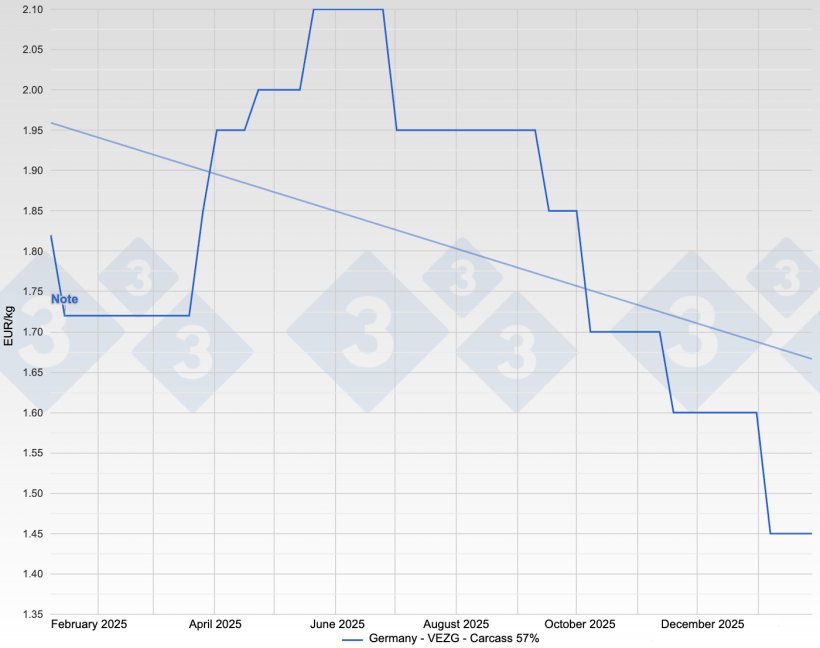
However, the fact that the quotation fell so sharply at the very beginning of the month, dropping from €1.60 to €1.45, came as a surprise to many. It was not the price reduction itself, but its dimension and speed that hit farms hard and led to a sobering start to the new year.

In the first days of January, it became clear how difficult it was for the market to absorb the after-effects of the year-end period. Slaughter-ready pigs accumulated while slaughtering, cutting, and processing operations only gradually returned to normal capacity. The reduction of overhangs progressed slowly and differed markedly from region to region.
At the same time, the meat market was amply supplied, meaning that no relieving impulses came from that side. Once the lower price level had been reached, the quotation stabilised at €1.45 over the remainder of the month. This sideways movement brought a certain degree of calm to the market but did little to ease the tense mood. Disappointment over the abrupt downturn at the start of the month ran deep and shaped discussions along the entire value chain.
Meat sales remained subdued throughout January. After the holiday season, demand was predictably restrained, and despite individual promotional campaigns in food retail, there was a lack of any decisive momentum. Cuts could be marketed continuously, but there was no sign of scarcity whatsoever. Many market participants described trading activity as solid but lacking energy. Only towards the end of the month did indications increase that overhangs on the live pig market were slowly shrinking and that slaughter weights had passed their peak. This development fostered cautious optimism, even if it could not fully erase the bitter start to January.
Piglets: gradual stabilisation without upward momentum
The piglet market showed signs of stabilisation over the course of the month. Following previous price reductions, supply and demand found better balance again. Marketing free batches remained challenging in some cases, but overall piglet traders reported more balanced conditions.
Weather-related demand increased at times in order to avoid empty barns. As a result, the piglet market proved more stable than the slaughter pig market, though without generating genuine upward impulses.
Sows: high pressure and concern over the economic situation
The situation remained noticeably more strained in the sow segment. Supply was extensive throughout much of the month and met a well supplied sow meat market with limited demand momentum. Competitive pressure was intense, driven not only by the plentiful availability of cuts from slaughter pigs but also by increased low priced offers from within the European market.
The ongoing ASF-related export restrictions affecting Spain played a role, as additional volumes were channelled into intra European trade and intensified competition. Against this backdrop, the VEZG quotation for slaughter sows declined over the course of the month and most recently stood at €0.68 €. The lower payout prices announced by major slaughter companies such as Tönnies and Westfleisch added to the uncertainty. On many farms, concerns grew that the economic situation in sow production could deteriorate further.
Political and structural factors shape the sector
Beyond pure market developments, political and structural issues played a major role in January. Considerable attention was given to the federal programme for restructuring livestock housing. The German government announced that the programme would be discontinued prematurely due to insufficient uptake. At the same time, the submitted applications highlighted the immense investment pressure, especially in sow production. Industry surveys estimate that several billion euros will be required to implement the new standards for mating centres and farrowing facilities. Many farms see themselves unable to shoulder these sums without reliable funding support. Accordingly, fears of a further wave of exits from piglet production are widespread. Without grandfathering provisions for existing farrowing facilities and without follow-up support, many market participants believe a structural break is looming that could sustainably weaken domestic production.
This complex situation was further shaped by additional political signals. The confirmation of Germany’s status as free from foot-and-mouth disease without vaccination by the World Organisation for Animal Health was widely regarded within the industry as an important signal. It strengthens Germany’s position in international trade and underlines the importance of effective animal disease control. At the same time, the debate surrounding the future of livestock support made clear how strongly political frameworks now influence economic decisions on farms.
Europe and ASF in Spain shape the competitive environment
International developments affected the German market mainly indirectly during the reporting month. Within Europe, quotations stabilised overall, but competitive pressure remained high. A key factor was the continued impact of African swine fever in Spain here as well. Export restrictions linked to the disease have forced significant volumes of Spanish pork back onto the European internal market. These additional flows intensified competition within the EU and contributed to an abundant supply situation, particularly in the meat trade. As a result, relief from abroad failed to materialise for Germany. Market stabilisation could therefore only come from within the system itself, through the gradual reduction of overhangs and a slowly improving meat demand.
The outlook remains cautious but not without hope. In the coming weeks, it will be crucial whether the reduction of overhangs continues and whether meat demand picks up in line with seasonal patterns. Political signals that provide planning security for farms will be equally important. January 2026 clearly demonstrated how sensitive the market currently is. Farmers had anticipated lower prices, but the severity of the downturn at the start of the month came as a surprise and was a heavy blow for many. Whether the subsequent stabilisation will develop into a sustainable recovery remains the key question for the near future.